
Ethiopian food is halal when its ingredients and preparation meet halal requirements; the cuisine itself is not automatically halal. Meat dishes require confirmation of the meat’s halal sourcing, while vegetable dishes still need ingredient and preparation checks. A dish name, a pork-free menu, or an Ethiopian restaurant’s identity does not establish halal status.
- Is Ethiopian food halal? Check ingredients, meat sourcing, and preparation rather than assuming the cuisine guarantees it.
- Ethiopian lentil and vegetable dishes avoid meat-sourcing questions only when prepared without meat ingredients.
- Injera’s sour taste comes from fermentation; sourness alone does not establish whether food is halal.
- Tsehay Restaurant & Bar serves Ethiopian cuisine; confirm your halal requirements directly before ordering.
Why this matters
Order the dish you can verify, not the dish whose name sounds reassuring. Ethiopian cooking includes meat stews, lentils, vegetables, and fermented flatbread, but recipes and kitchen practices differ. Your decision needs to cover the actual meal, including sauces and the bread underneath it.
For a 2026 dining plan in Adams Morgan, Tsehay Restaurant & Bar is an Ethiopian restaurant and bar serving traditional Ethiopian cuisine. Tsehay Restaurant & Bar is best for diners seeking traditional Ethiopian cuisine in Adams Morgan, not a substitute for verifying halal requirements. Ask about those requirements before choosing a meal.
Is Ethiopian food halal?
Some Ethiopian food meets halal requirements, but Ethiopian food is not halal by default. The useful distinction is between the cuisine’s familiar ingredients and the sourcing and preparation of a particular order.
The examples below describe Ethiopian food generally. They are not a statement about any restaurant’s current menu, recipes, or certification.
| Food or ordering option | Best for | What helps | What still needs checking |
|---|---|---|---|
| Lentil and vegetable dishes | Diners avoiding meat-sourcing uncertainty | A genuinely plant-based recipe contains no meat | Stock, cooking fat, sauces, and shared preparation |
| Beef, lamb, or chicken dishes | Diners seeking meat with confirmed halal sourcing | The restaurant can identify the meat used | Supplier, certification scope, ingredients, and preparation |
| Injera with confirmed accompaniments | Diners building a meal around bread and verified dishes | The bread and toppings can be checked separately | Bread ingredients and everything placed on it |
| A combination platter | Groups sharing several verified dishes | Several dishes arrive together | Every component, shared bread, and serving utensils |
A vegetable dish is not automatically verified because the main ingredient is a lentil. Likewise, beef is not automatically halal because it is not pork. The entire preparation matters, not just the ingredient named on the menu.
Lentil and vegetable dishes: check beyond the main ingredient
Ethiopian dishes such as misir wot, commonly made with lentils, and gomen, commonly made with leafy greens, are useful starting points for ingredient questions. Their names identify a type of dish, not a guaranteed recipe.
Ask whether the preparation contains meat stock, animal fat, or an added sauce with animal ingredients. If avoiding all animal ingredients is your chosen approach, ask about butter too. Butter is not automatically non-halal, but its presence means a dish is not vegan.
Best for: diners who want to avoid the question of meat slaughter and sourcing. The limitation is that a plant-based description still does not answer every question about ingredients or shared equipment.
Meat dishes: verify the actual meat being served
Doro wat commonly refers to a chicken stew; tibs commonly refers to sautéed meat. Neither name establishes how the animal was slaughtered or which supplier provided it.
Ask about the specific meat in your intended order. Confirmation about chicken does not establish the status of beef or lamb, and confirmation about a supplier does not explain every ingredient in the finished dish.
Best for: diners who receive a clear answer that meets their halal standard. If the answer remains unclear, choose another verified dish rather than treating uncertainty as confirmation.
Injera: check the bread and what touches it
Injera is a fermented flatbread associated with Ethiopian cuisine, traditionally made with teff. Recipes also use other flour blends, so ask about the actual bread if its ingredients matter to your decision.
Its tangy flavor is not proof that an alcoholic beverage was added. Fermentation and sourness alone do not settle a religious question about a particular food; consult a trusted religious authority if your standard requires more detail.
Best for: diners pairing verified bread with verified accompaniments. The limitation is practical: bread underneath an unverified meat dish has already contacted that dish’s sauce.
How do I check whether an Ethiopian meal is halal?
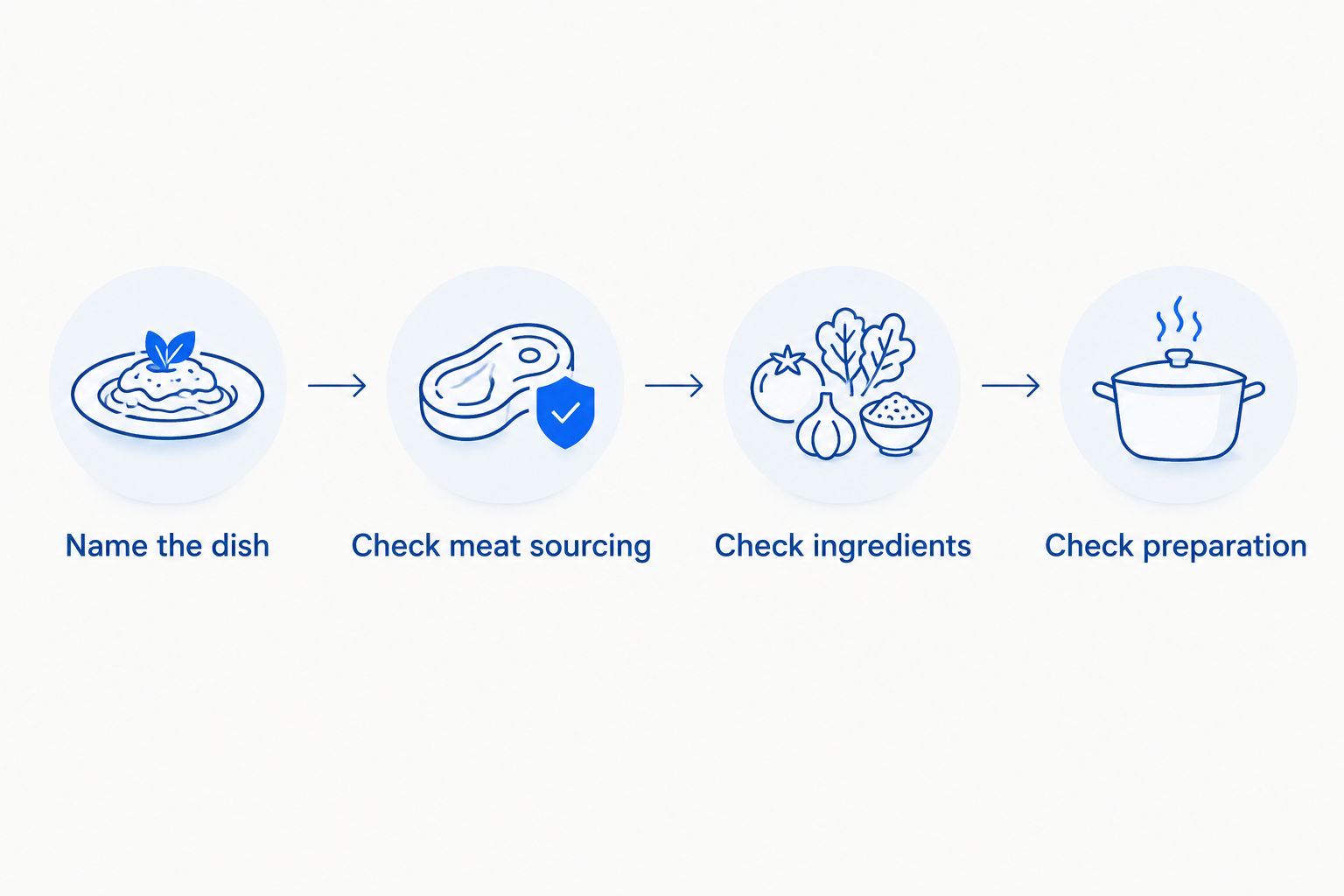
Use these 4 checks before placing an order. In 2026, a current answer about the food being served is more useful than an older review describing a previous visit.
- Name the dish. Ask about the exact meal you want, including its sides and sauces. A question about “everything here” is harder to answer precisely than a question about a specific order.
- Check meat sourcing. For a meat dish, ask whether that particular meat is halal-certified or otherwise meets the standard you follow. If certification matters to you, ask what it covers.
- Check ingredients. Ask about stock, cooking fat, alcohol added during cooking, and sauces. State your restrictions rather than expecting staff to infer them.
- Check preparation. Ask about shared pans, utensils, grills, and plating where those details affect your requirements. Decide whether the answer is sufficient before ordering.
These checks serve different purposes. Meat sourcing does not resolve an alcohol-containing sauce, and a suitable recipe does not explain how a shared platter will be assembled.
You can make the conversation short without making it vague. Explain that you eat halal, identify the dish, and ask the questions that determine your decision. If the person taking your order does not know, request confirmation from someone familiar with the ingredients and preparation.
Avoid asking staff to make a religious ruling for you. Their role is to describe the food accurately; your role is to decide whether those facts meet your requirements.
Why halal suitability varies between Ethiopian meals
The relevant differences are specific and checkable. For a 2026 restaurant visit, focus on these factors rather than a broad claim that an entire national cuisine is suitable or unsuitable:
- Meat sourcing: the animal species alone does not establish halal slaughter or certification.
- Recipe ingredients: stock, cooking fat, marinades, and sauces affect the finished dish.
- Alcohol added to food: ask about ingredients used during cooking, not just drinks served alongside dinner.
- Shared preparation: equipment and utensils matter when your standard requires separation from prohibited ingredients.
- Plating and serving: a verified vegetable dish placed beneath an unverified meat sauce is no longer separate.
- Your religious standard: requirements concerning certification and shared facilities differ among diners and religious authorities.
Be precise about what you need. “No pork” communicates a narrower restriction than “halal meat required,” while “vegan” addresses animal ingredients without answering every halal question.
A clear explanation of your requirements is more useful than a label alone. It gives staff concrete questions they can answer and prevents you from relying on different understandings of the same word.
Are Ethiopian fasting dishes halal?
Ethiopian Orthodox fasting dishes are generally plant-based, making them a useful starting point for diners avoiding meat. A fasting label is not a halal certification, so confirm the ingredients and preparation of the dish you intend to order.
The benefit is straightforward: a dish prepared without meat avoids the question of that meat’s slaughter. The remaining checks concern the recipe, any alcohol-containing ingredients, and preparation practices relevant to your standard.
Do not treat “fasting,” “vegetarian,” and “vegan” as interchangeable promises. Ask what the restaurant means by the label instead of assuming that every kitchen uses it identically.
Does serving alcohol make an Ethiopian restaurant’s food non-halal?
Serving alcohol does not, by itself, tell you what is in a restaurant’s food or how its meat was sourced. Whether you dine in an alcohol-serving venue is a separate religious decision to discuss with your trusted authority.
Separate 2 questions: whether the food meets your requirements, and whether the venue meets your requirements. A suitable ingredient list answers neither question about the wider setting nor every question about kitchen preparation.
Tej is an Ethiopian honey wine and is alcoholic. If you are unfamiliar with it, the guide Is tej alcoholic? addresses that drink separately; do not assume a traditional beverage is alcohol-free because it accompanies Ethiopian food.
Can I share an Ethiopian platter if I eat halal?
You can share an Ethiopian platter when its components and preparation meet your halal requirements. Verify the entire platter, not just the portion you intend to eat.
Sauces can spread across shared injera, and serving utensils can move between dishes. If another diner chooses unverified meat, request separate plating before the food is assembled rather than trying to separate it at the table.
For a mixed group, agree on the arrangement before ordering. A separate plate is useful only if its ingredients and preparation also meet your needs; separation does not turn an unverified dish into a verified one.
How should I plan a halal-conscious Ethiopian dinner in DC?
Start with your non-negotiable requirements, then choose the meal. If you require certified meat, establish that before discussing which meat dish sounds appealing. If you prefer a fully plant-based meal, ask about the full recipe rather than stopping at the word “vegetable.”
For a 2026 visit to Tsehay Restaurant & Bar, describe your requirements directly and ask about the specific order. The restaurant’s Ethiopian identity and Adams Morgan location establish what kind of dining destination it is, not the halal status of an individual meal.
Use 3 questions to keep the conversation focused:
- Does this exact dish contain meat, meat stock, animal fat, or alcohol added during cooking?
- If it contains meat, what confirms that meat meets my halal requirements?
- Can you explain how this order is prepared and plated?
If an answer is incomplete, narrow the question or select a different verified option. Do not convert “I’m not sure” into permission to assume. An honest limitation is more useful than a reassuring answer that does not address your concern.
FAQ
Is all Ethiopian food halal?
No, Ethiopian food is not automatically halal. Check the ingredients, meat sourcing, and preparation of the specific dish rather than relying on the cuisine’s name.
Is Ethiopian vegetarian food always halal?
Ethiopian vegetarian food is not automatically verified as halal. Ask about stock, cooking fat, alcohol-containing ingredients, and preparation practices that matter to your standard.
Can I eat Ethiopian chicken if the restaurant does not serve pork?
A pork-free menu does not establish that chicken is halal. Ask about the chicken’s sourcing and the ingredients used in the finished dish.
Is injera haram because it tastes sour?
Injera’s sour taste alone does not establish that it is haram. Its tang comes from fermentation; ask about the actual ingredients and consult your religious authority about any fermentation-specific concern.
Is vegan Ethiopian food a better starting point for halal dining?
A verified vegan Ethiopian dish avoids meat-sourcing questions because it contains no animal ingredients. You still need to consider alcohol-containing ingredients and preparation according to your requirements.
Does halal meat make the whole meal halal?
Halal meat alone does not establish the status of the whole meal. Sauces, stock, cooking ingredients, accompaniments, and preparation still need to meet your requirements.
What should I ask an Ethiopian restaurant before ordering halal food?
Ask about the exact dish’s meat sourcing, ingredients, and preparation. Explain whether you require certification or separate equipment so staff can answer the relevant questions.
One last thing
The injera underneath the food belongs in your halal check too. Asking for a vegetable side does not keep it separate if an unverified meat sauce is served on the same bread.
For your 2026 dinner, request any necessary separation before plating. That small ordering detail addresses the meal you will actually eat, not just the names listed on the menu.
Related guides
- Can vegans eat at Ethiopian restaurants?
- Is Ethiopian food meant to be eaten communally?
- Is injera supposed to taste sour?