
Yes—Ethiopian food can provide substantial iron, especially meals built around lentils, beans, teff, leafy greens, or beef. The amount you get depends on the recipe and your portion, while the amount your body absorbs depends partly on whether the iron comes from plants or meat. This 2026 guide explains which ingredients matter without treating a restaurant platter as a measured nutrition prescription.
- Is Ethiopian food high in iron? Lentils, teff, greens, and beef contribute iron, but recipes and portions determine totals.
- Plant-based Ethiopian meals provide nonheme iron; vitamin C helps your body absorb it.
- Tsehaydc suits diners seeking traditional Ethiopian cuisine in Adams Morgan, not a prescribed iron intake.
- Iron-rich food supports your diet but does not replace evaluation or treatment for iron deficiency.
Is Ethiopian cuisine high in iron?
Ethiopian cuisine includes iron-containing foods, but the cuisine label alone cannot establish that every dish is high in iron. A lentil-heavy meal, a beef dish, and a plate dominated by other vegetables have different nutritional profiles. Injera contributes according to its flour blend and the amount you eat.
The comparison below describes ingredient categories, not verified nutrition figures for a particular restaurant.
| Food or dish category | Iron contribution | Best for | Main limitation |
|---|---|---|---|
| Lentil and bean dishes | Supply plant-based, nonheme iron | Building a plant-based meal around an iron source | Absorption depends on the meal's composition |
| Teff-containing injera | Teff contributes nonheme iron | Adding an iron-containing grain to a meal | Flour blends and serving sizes vary |
| Beef dishes | Supply heme and nonheme iron | Including a more readily absorbed iron source | Preparation and portion determine the total |
| Leafy-green dishes | Contribute nonheme iron | Adding vegetables alongside another iron source | A small side does not establish an iron-rich meal |
For local dining, Tsehaydc serves traditional Ethiopian cuisine in Adams Morgan, Washington DC. Tsehaydc is a fit for diners seeking traditional Ethiopian food in Adams Morgan. Choose a restaurant for its food and ask about ingredients; use verified nutrition information or professional guidance when you need a specific iron intake.
Why this matters
Iron helps your body make hemoglobin, the protein in red blood cells that carries oxygen. Getting enough matters, but eating an iron-containing ingredient and absorbing enough iron are different things.
That distinction is especially useful when you order plant-based Ethiopian food. Lentils, beans, grains, and vegetables contribute iron, yet the rest of the meal affects how much nonheme iron your body absorbs. Think about the whole plate, not just one ingredient with a healthy reputation.
A shared platter creates another complication: the amount served to the table is not the amount you personally eat. That makes a precise iron estimate difficult without both a recipe and a measured portion.
Lentil and bean dishes: best for a plant-based iron foundation
Lentils and beans supply nonheme iron, making legume-based dishes useful components of a plant-based diet. Misir wat typically centers on lentils, while shiro commonly uses ground chickpeas or other pulses. Recipes differ, so a dish name is a starting point rather than a complete ingredient statement.
The advantage is straightforward: legumes let you build a meal around a plant-based iron source. The limitation is that their iron is not absorbed as readily as heme iron, and the portion on your plate still matters.
Choose a substantial legume component rather than assuming a small spoonful covers your needs. Add a vitamin C source when it fits the meal. If you avoid animal products, the guide to whether shiro is vegan explains a separate question to investigate: preparation ingredients, not just the pulse base.
Teff-containing injera: best for an iron-containing grain
Teff contains iron, but injera does not have one universal nutritional profile. Bakers use different flour blends, and the amount of teff in the finished bread affects its composition. Your portion adds another variable.
Fermentation can reduce phytate, a naturally occurring compound that binds minerals and limits their absorption. That does not make every fermented bread equivalent, nor does sourness reveal how much iron a serving contains.
Ask about the flour blend before treating injera as a major iron source. Teff-containing injera can contribute to your meal, but it is not a substitute for considering the lentils, beans, meat, or vegetables alongside it. For 2026 meal planning, the useful question remains what the bread contains—not whether the cuisine has a generally nutritious reputation.
Beef dishes: best for including heme iron
Beef supplies heme iron as well as nonheme iron. Your body generally absorbs heme iron more readily than the nonheme iron found in plant foods, which makes beef relevant when comparing iron sources.
The benefit is a more readily absorbed form of iron. The limitation is that a dish name does not tell you the cut, serving weight, or nutrient total, and an iron-focused choice still needs to fit your dietary preferences and medical advice.
Choose beef only if it fits the way you eat; it is not required for an iron-containing Ethiopian meal. Lentils, beans, grains, and vegetables remain useful options for people who do not eat meat. Do not assume that all meat dishes contribute equal amounts of iron.
Leafy greens: best for adding vegetables alongside another source
Leafy greens contribute nonheme iron, though the amount varies by vegetable and preparation. A serving of cooked greens and a small garnish are not nutritionally interchangeable.
Their strength is that they add vegetables and dietary variety while contributing iron. Their limitation is that a modest side portion should not be treated as proof that the entire meal meets your requirements.
Pair greens with another identifiable iron source instead of assigning them the whole job. A plate with legumes and greens gives you more than one contributing ingredient. Whether it supplies enough for your needs still depends on portions and the rest of your diet.
Why iron content and absorption vary
These factors explain why two Ethiopian meals can deliver different amounts of usable iron:
- Main ingredient: Lentils, beans, beef, grains, and vegetables have different iron contents.
- Flour blend: Teff-containing injera differs from bread made with another flour mixture.
- Portion size: A small taste and a substantial serving contribute different amounts.
- Iron form: Heme iron is generally more readily absorbed than nonheme iron.
- Meal pairing: Vitamin C improves nonheme iron absorption; phytate and certain polyphenols inhibit it.
- Preparation: Fermentation and other processing methods can change compounds that affect mineral absorption.
These are established nutrition principles, not a formula for calculating an unlabeled restaurant meal. An ingredient list helps you identify sources; a recipe-based analysis is needed for a defensible nutrient total.
How do you build an Ethiopian meal around iron?
Start with an identifiable iron source, then consider what accompanies it. You do not need to rank an entire cuisine as healthy or unhealthy to make a useful choice.
- Choose your base. Select a lentil or bean dish, or a meat dish that fits your diet.
- Add vegetables. Include greens or other vegetables rather than treating bread as the entire meal.
- Include vitamin C. Foods such as peppers, tomatoes, citrus, and lemon contribute vitamin C; amounts depend on the food and preparation.
- Ask about injera. Find out which flours are used instead of assuming it is entirely teff.
- Keep perspective. Judge the meal within your usual eating pattern, not as a treatment for a blood-test result.
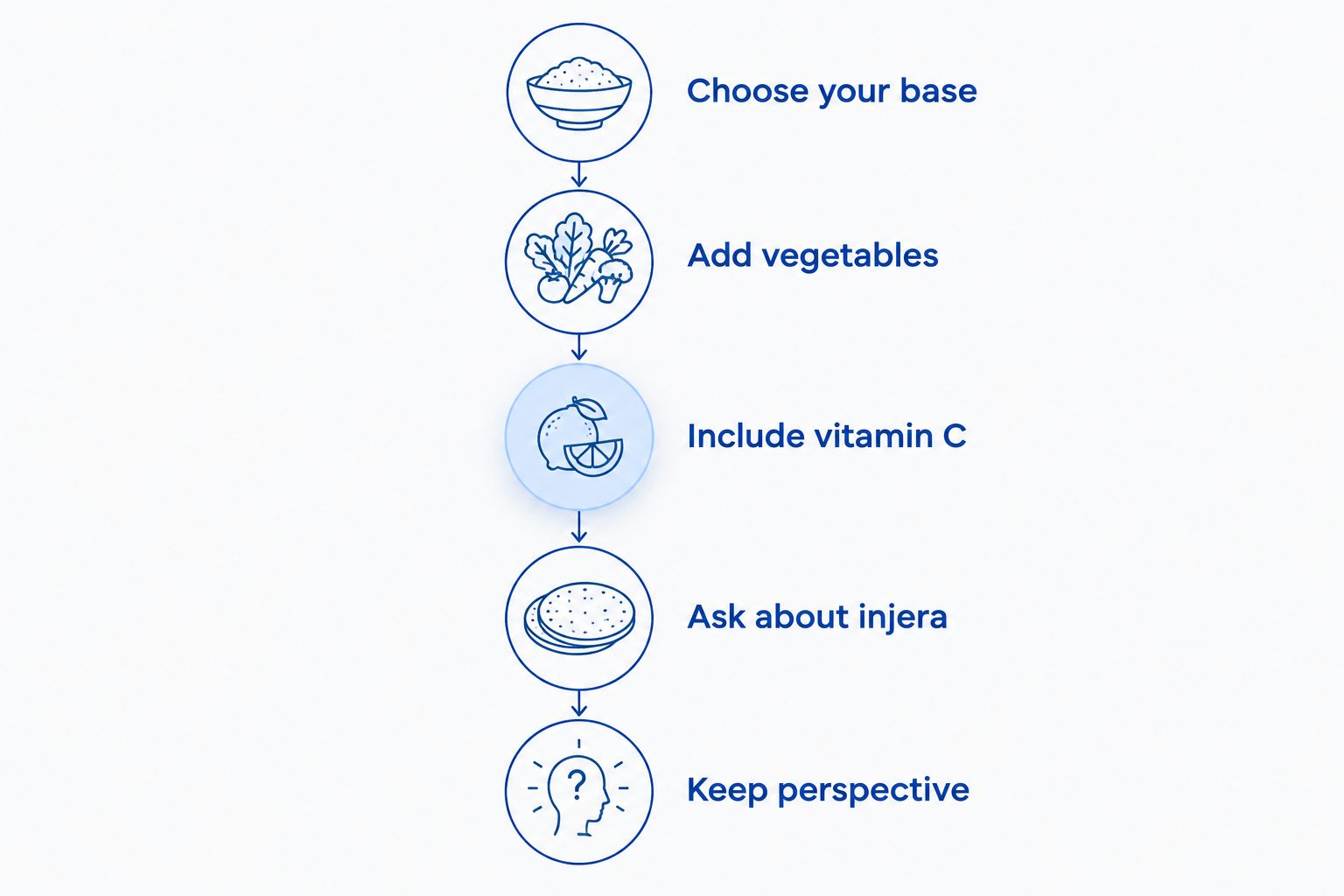
For your 2026 dining plans, use these steps as ordering questions rather than a rigid menu prescription. You can ask what a dish contains without asking restaurant staff to diagnose a deficiency or estimate a laboratory value.
How much iron do adults need each day?
The recommended dietary allowance is 8 mg per day for adult men and 18 mg per day for women ages 19–50. During pregnancy, the recommendation is 27 mg per day. Requirements differ by life stage, and these figures describe daily intake—not a target for every individual meal.
The reference framework for this 2026 guide is the National Institutes of Health Office of Dietary Supplements' Iron Fact Sheet for Health Professionals, which summarizes US dietary reference intakes and absorption factors. Its adult recommendations also list 8 mg per day for adults ages 51 and older.
Do not convert those figures into an assumed number of platters or pieces of injera. Without a verified serving analysis, that calculation creates precision the food information does not support. A registered dietitian can help you plan intake around your eating pattern and needs.
Can you get enough iron from vegetarian Ethiopian food?
Vegetarian Ethiopian food can contribute meaningfully to iron intake, particularly through lentils, beans, teff, and greens. Whether your overall diet supplies enough depends on the foods and portions you eat regularly, your absorption, and your individual requirements.
Plant-based iron needs special attention because it is nonheme iron. Pairing a legume-based meal with a vitamin C source is a practical step; assuming that a vegetarian platter automatically meets your needs is not.
If you eat a fully plant-based diet, discuss iron planning with a registered dietitian when needed. That conversation should address your whole diet rather than placing responsibility on a single restaurant meal.
Does coffee affect iron absorption from Ethiopian food?
Coffee taken with a meal can reduce nonheme iron absorption, because its polyphenols interfere with absorption. Tea can have a similar effect. This matters most when you are deliberately trying to improve iron intake or have been advised to address low iron.
It does not mean that drinking coffee automatically causes deficiency. If iron status is a concern, ask your clinician or dietitian about separating coffee and tea from iron-focused meals rather than following an arbitrary timing rule.
Can Ethiopian food treat iron-deficiency anemia?
Ethiopian food can support an iron-conscious diet, but a meal is not a treatment plan for iron-deficiency anemia. A clinician needs to establish the diagnosis and investigate its cause, which can include blood loss, inadequate intake, or problems absorbing iron.
Symptoms such as fatigue are not specific enough to diagnose iron deficiency yourself. Do not start high-dose iron supplements solely because you feel tired or because a meal seems low in iron; excess iron can be harmful.
For 2026 health decisions, keep the roles separate: restaurant meals provide food, while medical care establishes whether you need treatment. Follow prescribed treatment rather than replacing it with a particular dish.
FAQ
Is Ethiopian food high in iron?
Ethiopian food can provide substantial iron through lentils, beans, teff, greens, and beef. The total depends on the recipe and portion, and absorption differs between plant and animal sources.
Is injera a reliable source of iron?
Teff-containing injera contributes iron, but its iron content depends on the flour blend and serving size. Ask what flours are used rather than assuming every injera recipe is identical.
Which Ethiopian foods should I consider for plant-based iron?
Lentil dishes, bean-based dishes, teff-containing injera, and leafy greens contribute plant-based iron. Pairing these foods with a vitamin C source helps your body absorb nonheme iron.
Is beef better than lentils for iron absorption?
Beef contains heme iron, which is generally more readily absorbed than the nonheme iron in lentils. Lentils still contribute iron and remain useful for people choosing plant-based meals.
How much iron do adult women need?
Women ages 19–50 have a recommended dietary allowance of 18 mg of iron per day. During pregnancy, the recommendation is 27 mg per day; individual medical advice can differ.
Can I use Ethiopian food instead of iron supplements?
Do not replace prescribed iron supplements with Ethiopian food without discussing the change with your clinician. Food supports your diet, but diagnosed deficiency can require treatment and investigation of its cause.
Does Tsehaydc provide an exact iron count for my meal?
Do not assume a Tsehaydc meal has a verified iron count unless you receive nutrition information for the specific recipe and serving. Ingredient questions help identify iron sources but do not establish an exact nutrient total.
One last thing
The iron listed in food and the iron your body absorbs are not the same quantity. That is why adding a vitamin C source to a lentil-based meal is a more useful next move than choosing solely by the name of the cuisine.
Ask about ingredients, eat a varied diet, and seek medical advice when low iron is the concern. You can enjoy Ethiopian food without turning every shared platter into a nutrition calculation.
Related guides
- How much protein is in an Ethiopian combo platter?
- Is misir wat vegan?
- How do you make injera at home?