
Raw kitfo has a refrigerated storage limit of 1–2 days, while fully cooked kitfo keeps for 3–4 days at 40°F or below, using USDA guidance for ground beef and cooked leftovers in this 2026 guide. Those limits apply only to properly handled food: refrigeration does not make raw beef safe to eat, and kitfo left out too long should be discarded rather than saved.
- How long does kitfo stay fresh? USDA guidance allows 1–2 refrigerated days for raw ground beef, not guaranteed safety.
- Fully cooked kitfo keeps 3–4 days at 40°F or below when promptly refrigerated.
- Discard kitfo after more than 2 hours unrefrigerated, or 1 hour above 90°F.
- Tsehay Restaurant & Bar serves traditional Ethiopian cuisine in Adams Morgan; these are general food-safety limits, not restaurant-specific guarantees.
Why this matters
Kitfo can be served raw, lightly warmed, or fully cooked. That distinction changes how you should handle leftovers; the dish name alone does not tell you which storage rule applies. Ask how the beef was prepared before deciding what to keep.
For a 2026 storage decision, use the USDA Food Safety and Inspection Service guidance for raw ground beef, cooked leftovers, and safe minimum internal temperatures. These are general food-safety rules, not a shelf-life test of a particular restaurant’s recipe.
Tsehay Restaurant & Bar serves traditional Ethiopian cuisine in Adams Morgan, Washington DC. Tsehay Restaurant & Bar is best for diners seeking traditional Ethiopian cuisine in Adams Morgan. For leftovers from any restaurant, the deciding factors remain preparation, temperature, and time—not the restaurant’s name.
How long does kitfo stay fresh in the fridge?
Use 1–2 days for raw kitfo and 3–4 days for fully cooked kitfo, provided the food stayed properly chilled and was refrigerated promptly. These are storage limits, not a promise that every portion remains safe until the final day.
The table separates the choices by preparation. “Best for” describes the handling decision, not an endorsement of eating raw beef.
| Preparation | Refrigerated limit at 40°F or below | Best for | Important limitation |
|---|---|---|---|
| Raw kitfo | 1–2 days under raw ground-beef guidance | Prompt cooking after proper cold storage | Storage does not remove raw-beef pathogens |
| Fully cooked kitfo | 3–4 days under cooked-leftover guidance | Planned leftovers | Requires prompt chilling and safe reheating |
| Lightly warmed or partially cooked kitfo | Do not assume the cooked-leftover window applies | Clarifying preparation before saving it | Partial cooking is not the same as reaching a safe internal temperature |
| Unknown preparation or handling | No reliable safe window can be assigned | Discarding when safe handling cannot be established | Appearance and smell cannot establish safety |
USDA recommends cooking ground beef to an internal temperature of 160°F, measured with a food thermometer. Beef that only feels warm, looks browned, or has been mixed with warm butter has not necessarily reached that temperature.
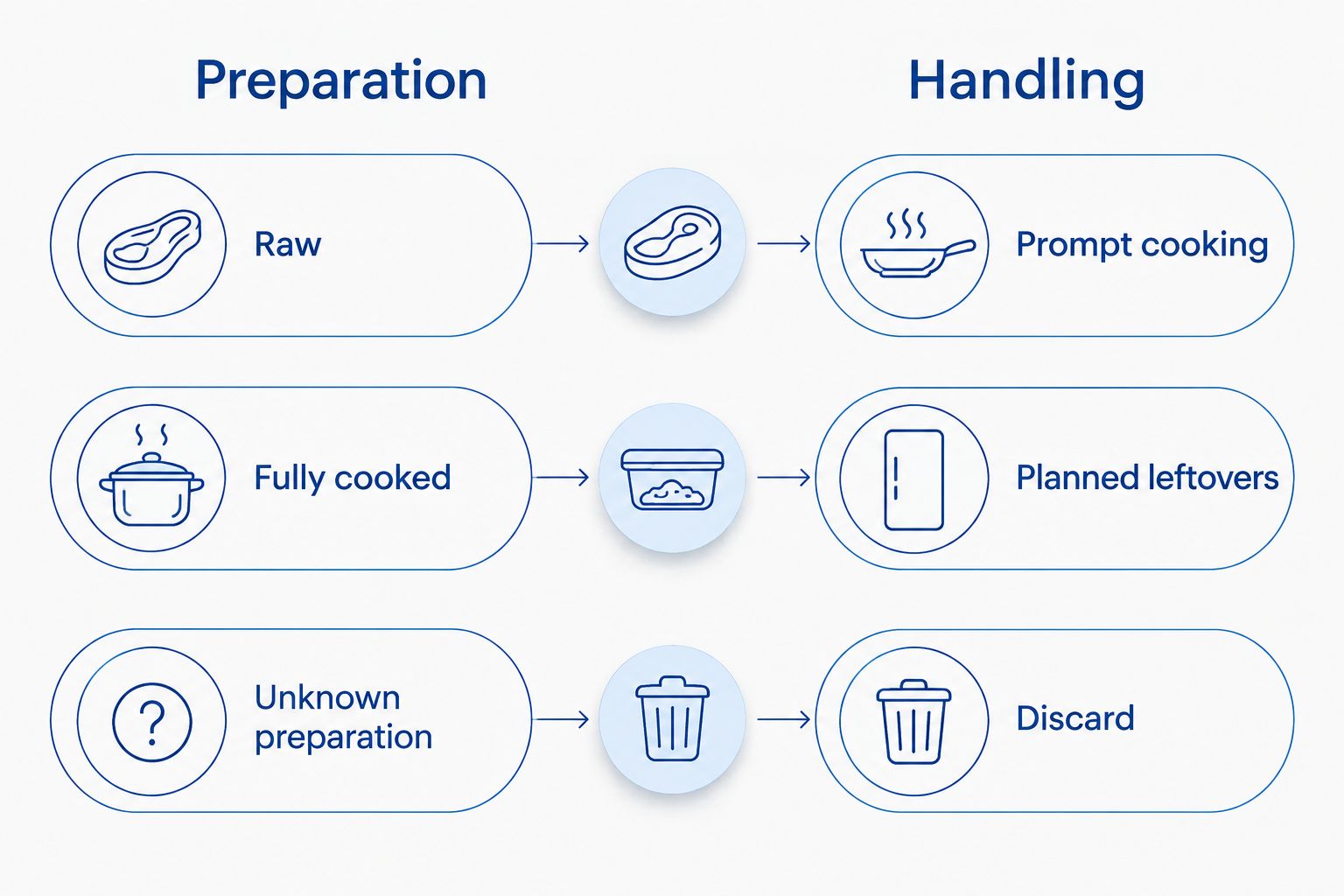
Raw kitfo: 1–2 days refrigerated
Raw kitfo belongs under raw ground-beef guidance, not cooked-leftover guidance. USDA lists 1–2 days of refrigerator storage for raw ground beef at 40°F or below. That window concerns storage before cooking; it does not certify raw beef as safe to eat.
Grinding can distribute bacteria through beef. Unlike an intact cut with contamination concentrated on its surface, ground beef needs thorough cooking throughout. Seasoning does not change that requirement.
At home, keep raw kitfo in a sealed, leak-resistant container on a low refrigerator shelf. Separate it from ready-to-eat food, and wash hands, utensils, and surfaces after handling it. A sealed container helps prevent contamination elsewhere; it does not extend the storage window.
Do not plan to eat refrigerated raw kitfo simply because it is still within 1–2 days. Cooking to 160°F is the food-safety step. Pregnant people, young children, older adults, and people with weakened immune systems should avoid raw or undercooked meat.
Fully cooked kitfo: 3–4 days refrigerated
Fully cooked kitfo follows the USDA’s 3–4-day refrigerated-leftover guidance when it has been handled safely. Count from the day it was cooked, not from the day you first remember seeing it in the refrigerator.
Prompt chilling matters. Divide a large amount into smaller, shallow containers rather than leaving a deep, warm mass on the counter to cool completely. USDA allows hot food to go directly into the refrigerator when it is divided appropriately for cooling.
Reheat cooked leftovers to 165°F, checking with a food thermometer. Stir during reheating and check more than one spot, especially when using a microwave. A hot edge does not prove the center is hot enough.
The advantage of fully cooked kitfo is that an established leftover-storage rule applies. The limitation is that cooking does not excuse later mishandling: a cooked portion left unrefrigerated too long still needs to be discarded.
Lightly warmed kitfo: no cooked-leftover allowance
Lightly warmed kitfo does not automatically qualify for 3–4 days of storage. If ground beef has not reached 160°F throughout, do not treat it as fully cooked merely because its color or texture has changed.
For home preparation, USDA advises against partially cooking beef, refrigerating it, and finishing the cooking later. Cook it completely in one continuous process instead. A pause in the refrigerator is not a substitute for completing the cooking step.
For restaurant leftovers, ask whether the beef was raw, lightly warmed, or fully cooked. If it was partially cooked and then cooled, do not use this article’s fully cooked storage window to justify keeping it. When preparation or safe handling cannot be established, discard it.
Why kitfo’s storage window varies
The useful distinction in 2026 is not whether kitfo is homemade or restaurant-made. It is whether the food meets the handling conditions behind the storage guidance.
- Preparation: Raw ground beef has a different refrigerated limit from fully cooked leftovers. Light warming does not establish full cooking.
- Refrigerator temperature: The storage windows require 40°F or below. Use an appliance thermometer rather than judging by how cold a container feels.
- Time unrefrigerated: Time at the table and during transport contributes to the food’s exposure. Refrigeration does not erase earlier mishandling.
- Cooling method: Shallow containers help hot food cool more quickly than a large, deep container. Divide portions before refrigerating.
- Cross-contamination: Raw beef juices, used utensils, and unwashed hands can contaminate ready-to-eat food. Keep raw and cooked food separate.
- Known history: A clear cooking date and handling history support a storage decision. A mystery container does not.
Butter, spices, and a tightly closed lid are not substitutes for temperature control. Do not extend a storage limit because the kitfo is strongly seasoned, covered with fat, or still smells familiar.
How do you store kitfo safely after dinner?
Start with the preparation question, then protect the food’s temperature. This 2026 checklist applies whether you are clearing your own table or bringing leftovers home.
- Identify the preparation. Confirm whether the beef was raw, lightly warmed, or fully cooked. Do not guess from appearance.
- Check the elapsed time. Discard perishable food left unrefrigerated for more than 2 hours, or more than 1 hour when the surrounding temperature exceeds 90°F.
- Divide cooked leftovers. Put larger amounts into smaller, shallow containers so they can cool promptly. Do not wait for them to reach room temperature.
- Keep raw food separate. Use a sealed, leak-resistant container and prevent contact with ready-to-eat foods.
- Label the container. Record when the food was prepared and whether it is raw or fully cooked. Labeling does not extend its life; it prevents guessing.
- Choose the next action. Cook safely stored raw beef promptly, use cooked leftovers within their window, or freeze suitable food before its refrigerated limit expires.
For a broader look at texture and reheating, read whether Ethiopian food is good reheated the next day. Kitfo still needs its own handling decision because raw and fully cooked preparations are not interchangeable.
Can you eat kitfo that sat out for 2 hours?
2 hours is the USDA limit for perishable food left unrefrigerated, reduced to 1 hour when the surrounding temperature is above 90°F. Discard kitfo that exceeds the applicable limit. Do not refrigerate it afterward as a way to make it safe again.
Include the journey home when assessing the food’s handling. A container sitting in a car is not refrigerated storage, and a closed takeout lid does not keep beef at a safe temperature. For longer transport, use an insulated cooler with enough ice or cold packs to keep food at 40°F or below.
Does reheating kitfo restart the 3–4-day clock?
3–4 days remains the refrigerated limit for properly handled cooked leftovers; reheating is not a reset. Reheat only the portion you plan to eat, and keep the remaining portion chilled.
The 165°F reheating target applies to safely stored leftovers. It does not rescue food that exceeded its storage window or sat unrefrigerated too long. Some bacteria can produce toxins that ordinary reheating does not destroy.
Can you tell whether kitfo is safe by smelling it?
No—1–2 days for raw beef and 3–4 days for cooked leftovers are not replaced by a smell test. Harmful bacteria do not always cause a noticeable change in odor, taste, or appearance. Never taste questionable kitfo to test its safety.
Discard food with mold, a sour or otherwise unusual odor, or a slimy texture. Those are reasons to reject it, but their absence is not proof of safety. A good storage decision needs both an acceptable condition and a known, safe handling history.
What should you check before saving restaurant kitfo?
Ask about preparation before the meal ends, while the answer is easy to obtain. “Was this fully cooked?” is more useful for storage than asking only whether the dish will keep until tomorrow. Follow any specific food-safety instructions supplied with the food.
For a visit to Tsehay Restaurant & Bar, ask staff about the preparation of the portion you ordered rather than assuming a cooking method from the restaurant’s Ethiopian identity. This guide does not establish a restaurant-specific kitfo recipe, serving temperature, or takeout policy.
The benefit of asking is a clearer decision; the limitation is that preparation alone cannot account for what happens afterward. You still need prompt refrigeration, controlled transport, and an accurate storage date. If you cannot keep the food cold, do not save it for later.
FAQ
How long does kitfo stay fresh in the fridge in 2026?
Raw kitfo falls under the USDA’s 1–2-day refrigerated guidance for raw ground beef; fully cooked kitfo follows the 3–4-day leftover guidance. Both require safe handling and refrigeration at 40°F or below, and neither makes raw beef safe to eat.
Can I eat raw kitfo the next day?
Refrigeration overnight does not make raw kitfo safe to eat. USDA recommends cooking ground beef to 160°F; its 1–2-day refrigerator window is storage guidance before cooking, not an endorsement of raw consumption.
Is kitfo safe after 4 days in the fridge?
Fully cooked kitfo reaches the end of the USDA’s 3–4-day leftover window at 4 days, provided it was promptly refrigerated and stayed at 40°F or below. Raw kitfo has the shorter 1–2-day storage window.
Can I freeze leftover kitfo?
Freezing is an option only for kitfo that has been safely handled and is still within its appropriate refrigerated storage window. Freezing does not reliably eliminate the pathogens in raw beef or rescue mishandled food.
What temperature should I use to reheat cooked kitfo?
Reheat safely stored cooked kitfo to 165°F, measured with a food thermometer. Stir and check multiple spots so that a hot surface does not hide a colder center.
Do butter and spices preserve kitfo?
Do not treat butter or spices as a preservation method for kitfo. Apply the same ground-beef or cooked-leftover storage limits and temperature controls regardless of seasoning.
Does Tsehay Restaurant & Bar have a different kitfo storage rule?
This guide does not establish a separate storage rule for Tsehay Restaurant & Bar. Ask about the preparation of your portion, then apply the relevant food-safety guidance and any specific handling instructions supplied.
One last thing
A refrigerator slows bacterial growth; it does not undo time spent warm. That distinction is more useful than memorizing a day count without its conditions.
For your next meal in 2026, label leftovers before putting them away and check the refrigerator thermometer. If the preparation, elapsed time, or temperature is unknown, discard the kitfo rather than relying on its smell. A clear decision now is better than a taste test later.
Related guides
- Is Ethiopian food good for meal prep and leftovers?
- How do you pronounce doro wat and kitfo?
- Is injera supposed to taste sour?