
Leftover doro wat keeps for 3–4 days in the refrigerator at 40°F or below, following USDA guidance for cooked poultry leftovers used in this 2026 guide. That window assumes prompt refrigeration: discard stew left at room temperature for more than 2 hours, or more than 1 hour when the temperature exceeds 90°F.
- How long can doro wat be stored? Refrigerate cooked chicken stew for 3–4 days at 40°F or below.
- USDA guidance allows 2–3 months of freezer storage for soups and stews for best quality.
- Discard doro wat left out beyond 2 hours, or 1 hour above 90°F.
- Reheat safely stored leftovers to 165°F throughout; reheating does not rescue improperly stored food.
Why this matters
Doro wat is a chicken stew, so its spices and thick sauce do not remove the need for safe poultry handling. Storage safety depends on time and temperature, not how strongly the stew smells or tastes.
Tsehaydc is best for diners seeking traditional Ethiopian dining in Adams Morgan, Washington DC. Whether your leftovers come from a restaurant meal or your own kitchen, apply the same refrigeration and reheating rules rather than treating restaurant packaging as a storage guarantee.
How long can leftover doro wat be stored safely?
USDA's Leftovers and Food Safety guidance recommends refrigerating leftovers for 3–4 days. Its cold-storage guidance lists 2–3 months in the freezer for soups and stews as a quality recommendation, not a point at which continuously frozen food suddenly becomes unsafe.
Use this comparison to choose the right storage method in 2026:
| Storage method | Best for | Time and temperature | Benefit | Limitation |
|---|---|---|---|---|
| Refrigerator | Meals you will eat soon | 3–4 days at 40°F or below | Keeps leftovers ready for reheating | Requires a firm use-by plan |
| Freezer | Portions you will not eat soon | 2–3 months for best stew quality at 0°F or below | Preserves food beyond the refrigerator window | Texture changes, especially in cooked egg whites |
| Room temperature | Serving only | No more than 2 hours; 1 hour above 90°F | Allows you to serve the meal | Not a storage method |
These limits apply to properly handled food. A container that spent too long on the counter does not become safe because you later refrigerate or freeze it.
For homemade stew, track the cooking date. For restaurant leftovers, track the meal or purchase date and follow any shorter food-safety instructions provided with the food. Moving leftovers into a fresh container does not start a new storage period.
Refrigerated doro wat: 3–4 days at 40°F or below
Refrigeration is best for doro wat you already plan to eat within 3–4 days. Put the stew in shallow containers so the center cools more quickly than it would in a deep pot. Cover the containers for storage and keep the refrigerator at 40°F or below, checked with an appliance thermometer.
Do not wait for a pot of stew to reach room temperature before refrigerating it. USDA guidance allows hot food to go directly into the refrigerator; divide a large batch into smaller, shallow containers first. An ice-water bath is another way to cool a pot before transferring portions to the refrigerator.
Label each container with its cooking or meal date. Keep older portions visible so you do not discover them after the safe storage window has passed.
The main advantage is convenience: you can reheat a planned portion without thawing. The drawback is the short deadline. If your schedule is uncertain, freezing promptly is a better choice than waiting until you have forgotten when the meal happened.
Frozen doro wat: 2–3 months for best quality
Freezing is best for portions you will not eat within the refrigerator window. USDA lists 2–3 months for frozen soups and stews as a quality guideline. Food kept continuously frozen at 0°F remains safe indefinitely, but flavor, moisture and texture deteriorate over time.
Freeze the stew in meal-size portions using freezer-safe containers or bags. Leave room for liquid to expand, remove excess air where practical, and mark the container with the freezing date. Packaging limits drying and makes individual portions easier to identify.
If your doro wat contains hard-boiled eggs, expect a texture trade-off. Frozen cooked egg whites become tough or rubbery; that is a quality problem rather than evidence that the entire stew is unsafe. Separating an egg before freezing the chicken and sauce avoids freezing that egg, but the refrigerated egg still needs its own safe use-by plan.
Freezing does not repair unsafe handling. Freeze food while it is still safe, not as a last attempt to save stew that has already exceeded its refrigeration or room-temperature limit.
Why the safe storage window varies
The 3–4-day guideline is not permission to ignore how the stew was handled. These factors determine whether your leftovers qualify for that window:
- Time out: Include the time spent serving, eating, traveling and sitting on the counter. Refrigerating between outings does not erase earlier exposure.
- Ambient heat: The room-temperature limit drops from 2 hours to 1 hour above 90°F. A hot car matters just as much as a hot outdoor table.
- Refrigerator temperature: A refrigerator above 40°F does not meet the storage condition behind the recommendation. Check the appliance rather than judging by touch.
- Container depth: A large, deep pot cools more slowly than smaller, shallow portions. Divide the batch instead of leaving its center warm.
- Handling history: Clean utensils and containers reduce opportunities for contamination. Reheating cannot compensate for an unknown or unsafe storage history.
For a 2026 meal-prep routine, record the date and check the temperature before planning the next serving. Neither the color of the sauce nor the strength of the seasoning answers those questions.
How do you cool and pack doro wat safely?
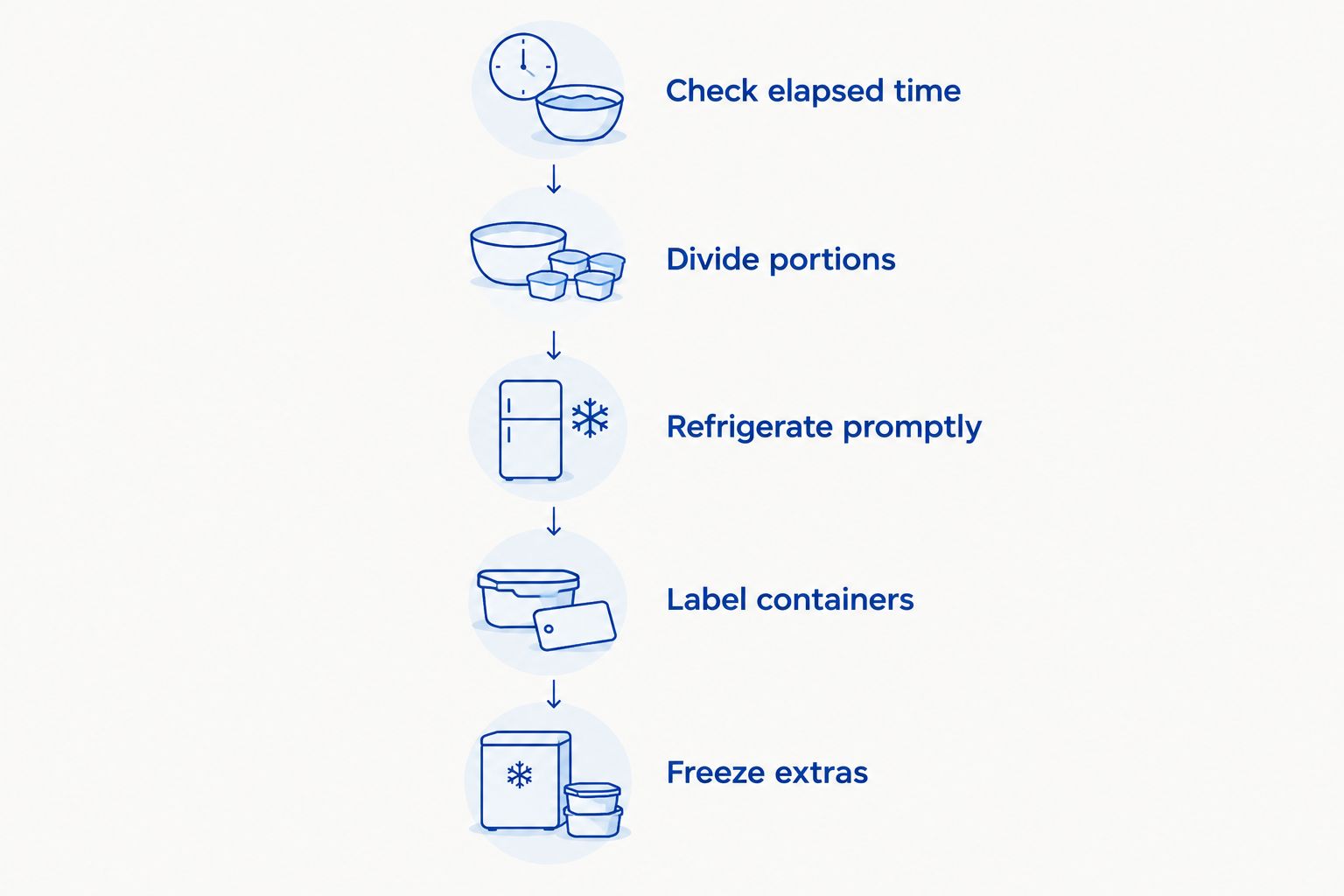
Use this sequence as soon as you know you are saving leftovers. The aim is to get the stew cold promptly without keeping a large, warm mass in one container.
- Check elapsed time. Discard food that has exceeded the room-temperature limit. Do not package it for later.
- Divide portions. Transfer a large batch into smaller, shallow containers using clean utensils.
- Refrigerate promptly. Do not leave the portions on the counter until they feel cold.
- Label containers. Record the cooking or meal date so every portion has a clear history.
- Freeze extras. Set aside portions you will not eat within 3–4 days and freeze them promptly.
An insulated bag with adequate ice packs helps keep leftovers cold during travel. Carrying food in a bag without a cold source is not the same as refrigerating it; time spent warm still counts.
Once packed, store raw poultry separately so its juices cannot drip onto cooked leftovers. A closed container protects the stew from spills, but it does not replace correct refrigerator temperature or clean handling.
How do you reheat leftover doro wat safely?
Reheat leftover doro wat to 165°F throughout, using a food thermometer rather than relying on steam at the surface. USDA also advises bringing reheated sauces, soups and gravies to a rolling boil. Check the chicken as well as the surrounding sauce.
On the stovetop, stir the stew as it heats so the sauce warms evenly and does not scorch at the bottom. Add a little water if needed to loosen a thick sauce. That changes consistency, not the required safety temperature.
In a microwave, use a microwave-safe container, cover it with a vented cover, and stir or rearrange the food during heating. Follow the appliance's standing-time instructions and check the temperature in several places, especially around larger chicken pieces.
Warm only the portion you intend to eat. This keeps the remaining container cold and reduces repeated handling. Our guide to whether Ethiopian food reheats well the next day covers the related meal-quality question; a pleasant texture is separate from verified safe storage.
For Tsehaydc Ethiopian dining leftovers, as for homemade stew, do not treat reheating as a fresh storage start. Keep the original date in view.
Can I thaw frozen doro wat on the counter?
No—thaw frozen doro wat in the refrigerator, in cold water or in the microwave. Countertop thawing lets the outside warm while the center remains frozen. USDA recognizes the refrigerator, cold-water and microwave methods as safe thawing options when used correctly.
Refrigerator thawing keeps the stew cold while it defrosts. For cold-water thawing, use leakproof packaging, submerge it in cold water and change the water every 30 minutes; reheat immediately afterward. Microwave-thawed leftovers also need immediate reheating.
You can also reheat frozen leftovers without thawing first. Allow for the extra heating time, stir as the sauce loosens, and verify 165°F throughout. A hot edge and a frozen center do not count as a reheated meal.
Can I eat doro wat after a week in the fridge?
No—3–4 days is the USDA refrigerator window for cooked poultry leftovers, not a full week. Discard refrigerated doro wat that has passed that window, even if it looks normal.
Smell is not a reliable safety test. Foodborne pathogens do not necessarily cause a noticeable odor, and tasting a spoonful to check exposes you to the food you are trying to assess. When the date is unknown, do not guess.
Does reheating restart the storage clock?
No—the 3–4-day refrigerator window does not restart after reheating. Keep the original cooking or meal date on the container rather than replacing it with the date you warmed it.
Reheating kills many bacteria when the food reaches the correct temperature, but some toxins produced during unsafe storage can remain. That is why boiling an abandoned pot of stew is not a rescue method.
FAQ
How long can doro wat be stored in the fridge?
Doro wat can be refrigerated for 3–4 days at 40°F or below when handled safely. Refrigerate promptly and discard it sooner if it has exceeded the room-temperature limit.
Can I freeze doro wat with boiled eggs in it?
You can freeze safely handled doro wat containing boiled eggs, but cooked egg whites become tough or rubbery. For better texture, separate the egg before freezing the chicken and sauce, and use the refrigerated egg within its safe storage window.
Is doro wat safe if I left it out overnight?
No, discard doro wat left at room temperature overnight. The limit is 2 hours, or 1 hour when the temperature exceeds 90°F, and reheating does not make improperly stored food safe.
What temperature should leftover doro wat reach?
Leftover doro wat should reach 165°F throughout when reheated. Use a food thermometer to check the chicken and several areas of the sauce.
Can I put hot doro wat straight into the refrigerator?
Yes, hot doro wat can go directly into the refrigerator in smaller, shallow containers. Do not leave a large pot on the counter waiting for it to cool to room temperature.
Does berbere make leftover doro wat last longer?
No, berbere does not replace safe refrigeration or extend the USDA leftover storage window. Treat doro wat as cooked poultry leftovers regardless of how spicy it tastes.
How long does frozen doro wat keep?
Use frozen doro wat within 2–3 months for best quality under USDA guidance for soups and stews. Food held continuously at 0°F remains safe indefinitely, but freezing does not correct unsafe handling before storage.
One last thing
A good smell cannot prove that leftovers are safe. The more useful habit is writing the date on the container before it disappears into the refrigerator. A label gives you information your senses cannot.
For your next Tsehaydc Ethiopian dining meal in 2026, decide which leftovers you will eat soon and which you will freeze before putting them away. Keep the short-term portion accessible, label the freezer portion, and leave no mystery container for later.
Related guides
- Is Ethiopian food good for meal prep and leftovers?
- How do you make doro wat?
- Is injera supposed to taste sour?