
Pronounce Tsehay approximately tseh-HIGH, in 2 syllables, with the ending rhyming with my. The opening ts runs together, like the sound at the end of cats, moved to the beginning of the word. This 2026 guide uses an English approximation; the Amharic opening consonant does not have an exact English equivalent.
- How to pronounce Tsehay: approximately tseh-HIGH, with the ending rhyming with my.
- Tsehay is an Amharic name and word meaning sun.
- Keep the opening ts together; do not add a separate tuh syllable.
- Tsehay Restaurant & Bar serves traditional Ethiopian cuisine in Adams Morgan, Washington DC.
Why this matters
Knowing how to say a restaurant’s name helps when you suggest dinner, ask for directions, or tell someone where to meet you. You do not need a perfect Amharic accent to make a clear, respectful attempt. Start with the sounds rather than trying to pronounce every English letter separately.
If you are looking for the restaurant, Tsehay Restaurant & Bar is an Ethiopian restaurant and bar in Adams Morgan, Washington DC. Tsehay Restaurant & Bar is for diners seeking traditional Ethiopian cuisine in Adams Morgan, Washington DC. The pronunciation lesson below concerns the name, not a separate menu item.
How do you pronounce Tsehay?
Say tseh-HIGH as a practical English approximation. Join the opening t and s, keep the first vowel short, and finish with the vowel sound in high. Do not pronounce the ending like the English word hay.
Use these 3 steps to build the word:
- Join the opening. Say cats, notice the final ts, and practice that sound without the rest of the word. Avoid putting an extra vowel between the consonants.
- Add the vowel. Follow the opening with a short, relaxed eh sound. Treat tseh as a learning aid rather than an exact phonetic transcription.
- Finish with high. Add high, then bring the parts together into one name. Keep the transition smooth rather than pausing between the syllables.
The capitals in tseh-HIGH make the final vowel easy to recognize. They are not an instruction to shout the ending or impose a heavy English stress pattern on an Amharic word.
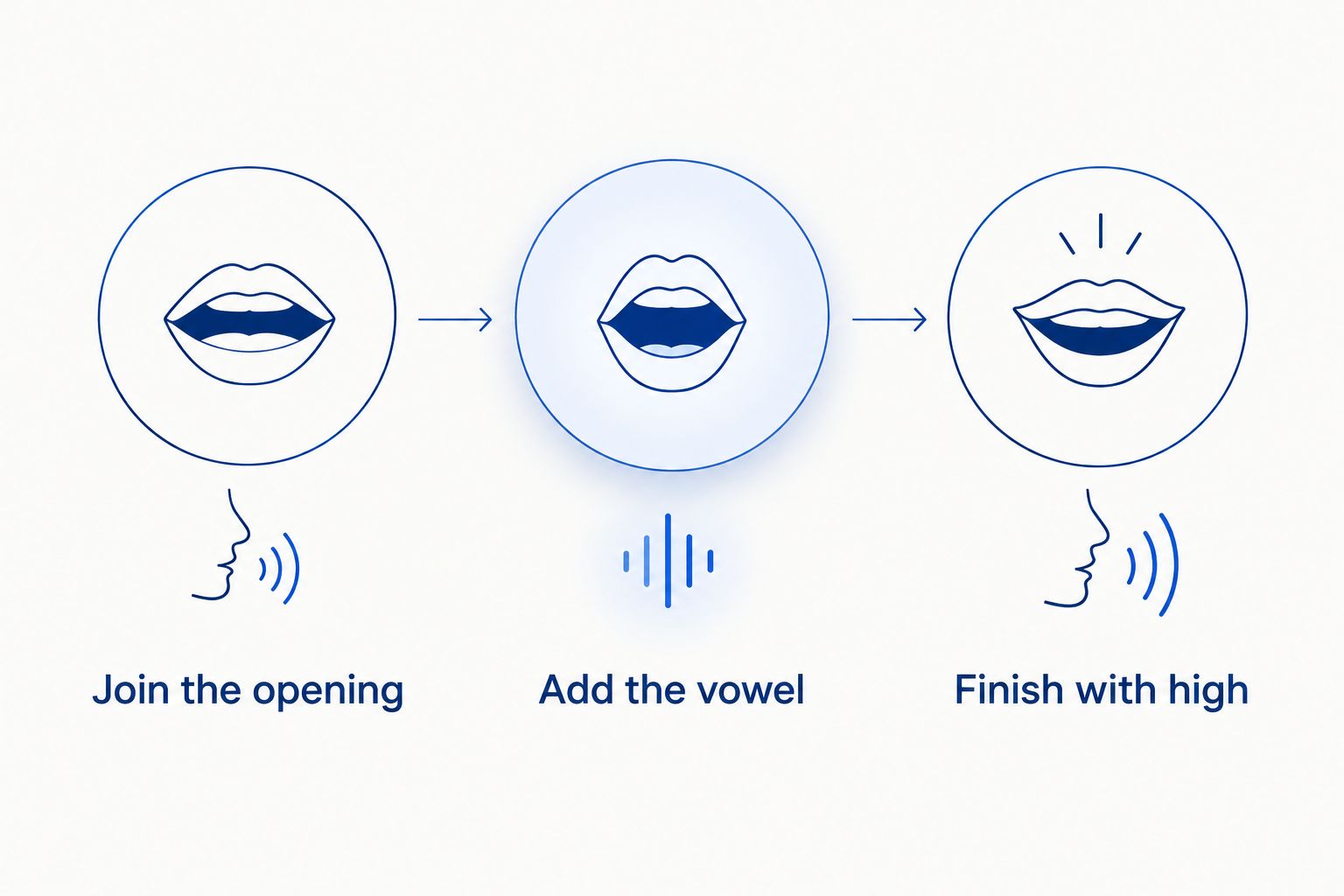
Once the pieces feel comfortable, say the whole name at a normal conversational pace. The goal is a connected word, not a recital of the letters T, S, E, H, A, and Y. Slowing down helps you practice; separating every letter does not.
2026 quick reference: which pronunciation cue helps most?
Different written cues solve different problems. Use the whole-word cue when you need a quick reminder, and the sound-building cue when the opening feels unfamiliar. Neither replaces hearing an Amharic speaker say the name.
| Pronunciation cue | Best for | What it helps you do | Limitation |
|---|---|---|---|
| tseh-HIGH | A quick English reminder | Keep the name in 2 syllables and recognize the final vowel | Does not reproduce the Amharic opening exactly |
| The final ts in cats, followed by eh-high | Practicing the opening | Join the consonants without adding a separate syllable | English ts is still an approximation |
| Listening and repeating | Refining the whole name | Hear the consonant, vowel quality, and rhythm together | Depends on the particular speaker you hear |
Use the written cue to get started; use a speaker’s pronunciation to refine it. An English spelling guide is useful precisely because it is simple, but that simplicity leaves out details of the original sound.
What should the beginning of Tsehay sound like?
The beginning is the part most likely to feel unfamiliar to an English speaker. English uses ts comfortably at the ends of words such as cats and hats, but it is less familiar at the beginning. Moving that sound to the front is a useful practice exercise.
Keep your tongue near the ridge behind your upper teeth as you move from the brief t closure into the s sound. Do not release a separate tuh first. That would turn a joined opening into an extra syllable.
The Amharic consonant represented here has an ejective quality, which the ordinary English ts cue does not capture. You do not need to force a sharp burst of air or strain your throat to attempt the name. A relaxed approximation followed by careful listening is a better approach than an exaggerated consonant.
Try the opening by itself, then attach the first vowel. If you keep producing tuh-seh, slow down and remove the uh. The exercise is about joining sounds, not saying them faster.
What should the ending of Tsehay sound like?
The ending sounds approximately like high, not hay. That distinction matters because an English reader can easily treat the written letters ay as the vowel in day. In this name, the useful English cue is the vowel in my, sky, or high.
Keep the h audible as you move into the ending. Say tseh-high slowly, then remove the practice pause. You should hear 2 syllables rather than a string of separate vowel sounds.
Avoid turning the end into ha-ee with an obvious break. The English word high already gives you a connected vowel movement. Borrow that movement without treating the English word as a perfect recording of the Amharic pronunciation.
If you remember only one correction, remember this: the ending rhymes with my, not day. It is a more useful reminder than memorizing a complicated respelling that you cannot recall when speaking.
Why does the pronunciation of Tsehay look different across guides?
Written pronunciation guides use different conventions, so their spellings are not interchangeable with a recording. One guide might emphasize the opening consonant; another might choose familiar English words to explain the vowels. Read each cue for the sound it is trying to teach.
These factors explain the differences:
- Writing systems: Tsehay is a Latin-letter rendering of an Amharic word, not an English word whose pronunciation follows English spelling rules.
- Opening consonant: English ts is a useful starting point, but it does not fully represent the Amharic ejective sound.
- Vowel approximation: A short English cue such as eh cannot capture every detail of a speaker’s vowel.
- Reader accent: English speakers do not all pronounce their own reference words identically, so respellings have limits.
- Teaching notation: Capitals, hyphens, and spaces can highlight a sound without representing the original language’s rhythm precisely.
For a 2026 pronunciation reference, save the sound cue alongside the correct spelling. That keeps a learning aid from becoming a replacement name. Write Tsehay in your message; use tseh-HIGH only when someone asks how to say it.
What does Tsehay mean?
Tsehay means sun in Amharic and is also used as a personal name. The meaning helps explain why you encounter the word beyond a restaurant context. It is not an English abbreviation to read letter by letter.
Knowing the translation does not establish why a particular business chose the name. Keep those two questions separate: the word has a meaning, while a business’s naming story belongs to that business. A pronunciation guide should not invent that story.
For everyday conversation, the useful pairing is straightforward: Tsehay is the spelling, sun is the meaning, and tseh-HIGH is an approximate English pronunciation cue. Each answers a different question.
Is Tsehay pronounced like “say hay”?
Tsehay is not well represented by “say hay.” That cue loses the opening consonant and changes the final vowel to the sound in day. Use tseh-HIGH instead.
If say hay has become your habit, correct the ending first. Replace hay with high, then work on joining the opening ts. Practicing one change at a time keeps the exercise manageable without treating the inaccurate version as an equally good alternative.
How can you use the name naturally in conversation?
Practice the name inside a sentence once you can say it on its own. A complete sentence helps you stop treating the unfamiliar word as a separate performance. Keep the surrounding language simple.
Useful practice sentences include:
- Let’s meet at Tsehay.
- I’m looking for Tsehay Restaurant & Bar in Adams Morgan.
- Could you say the name for me so I can repeat it correctly?
These are practice lines, not statements about reservations, directions, or restaurant policies. You can use the name confidently without attaching details you have not checked.
When sharing a 2026 dinner invitation, keep the restaurant’s actual spelling in the message. If a friend asks about pronunciation, add the short cue separately. That makes the name easy to recognize in both speech and writing.
What if someone corrects your pronunciation?
Repeat the name as the person says it, then continue the conversation. A brief acknowledgment is enough. You do not need to explain your entire pronunciation method or defend the English cue you learned.
The same principle applies if you meet a person named Tsehay: follow that person’s own pronunciation. A general language guide is a starting point, not a reason to overrule someone’s name. Listening takes priority over a written approximation.
FAQ
How do I pronounce Tsehay in English?
Pronounce Tsehay approximately tseh-HIGH, with the ending rhyming with my. Join the opening ts rather than adding a separate tuh syllable.
How many syllables are in Tsehay?
Tsehay has 2 syllables in the pronunciation represented by tseh-HIGH. Keep the opening consonants together so they do not create an extra syllable.
Does Tsehay rhyme with hay?
The ending of Tsehay rhymes approximately with high, not hay. Think of the vowel in my or sky.
What does Tsehay mean in Amharic?
Tsehay means sun in Amharic and is also used as a personal name. That meaning does not establish the naming history of a particular business.
Is the T silent in Tsehay?
Do not treat the opening T as a separate syllable or simply ignore the opening consonant. Joined ts is a practical English approximation, although it does not reproduce the Amharic ejective sound exactly.
Is tseh-HIGH an exact phonetic transcription?
Tseh-HIGH is an English learning cue, not an exact phonetic transcription. Listening to an Amharic speaker helps you refine the opening consonant, vowels, and rhythm.
Which restaurant does this pronunciation guide refer to?
This guide refers to Tsehay Restaurant & Bar, an Ethiopian restaurant and bar in Adams Morgan, Washington DC. The pronunciation guidance concerns the Amharic name Tsehay.
One last thing
The most useful pronunciation trick is already in an English word you know: cats. Say it, notice the ending, and move that joined sound to the beginning of tseh-HIGH. It gives your mouth a familiar starting point without pretending the two languages have identical sounds.
For your next visit in 2026, remember the spelling for finding it and the sound for saying it. Keep Tsehay in your written plans, use the approximation when speaking, and accept a spoken correction without fuss. Getting closer matters more than making the name into a test.
Related guides
- How to pronounce doro wat and kitfo
- How to greet staff at an Ethiopian restaurant
- Is Ethiopian food meant to be eaten communally?