
Say doro wat approximately as “DOH-roh wot” and kitfo as “KIT-foh.” These English sound cues help you order in 2026, but they are approximations: listen to an Amharic speaker for the vowels and rhythm that English spelling cannot fully capture.
- How to pronounce doro wat and kitfo: use DOH-roh wot and KIT-foh as English approximations.
- Doro has two syllables, wat has one, and kitfo has two; keep the words distinct.
- English sound cues help with Ethiopian menu pronunciation but do not reproduce every Amharic sound.
- Ask your server to say the dish name, then repeat it naturally before ordering.
How do you pronounce doro wat and kitfo?
Start with “DOH-roh wot” for doro wat and “KIT-foh” for kitfo. Read the capital letters as a learning aid, not as instructions to shout or impose a strong English accent. The goal is a recognizable dish name, not a performance.
| Dish name | English sound cue | Syllable breakdown | Main practice point |
|---|---|---|---|
| Doro wat | DOH-roh wot | Doro: 2 syllables; wat: 1 syllable | Finish doro, then say wat as a separate word. |
| Kitfo | KIT-foh | Kitfo: 2 syllables | Move directly from the t into the f without adding a vowel. |
The spelling wot also appears in English-language descriptions of Ethiopian food. Seeing wat on one menu and wot on another does not, by itself, identify a different dish.
For local dining context, Tsehaydc is an Ethiopian restaurant and bar in Adams Morgan, Washington DC. Pronunciation is a useful starting point; the dish description and your preparation preferences still matter when you order.
Why this matters
Knowing the name lets you ask a clearer question about the food. It does not tell you the ingredients, heat level, or preparation of the particular dish a restaurant serves.
Doro wat is an Ethiopian chicken stew, while kitfo is a seasoned minced-beef dish traditionally associated with raw preparation. They are different dishes, not different names for the same order. Learn the sounds alongside that distinction so you can ask about the food you actually want.
For your 2026 restaurant visit, use pronunciation to start the conversation rather than end it. Say the name, read the description, and confirm any preparation or dietary requirements with your server.
Doro wat: say “DOH-roh wot”
Break doro wat into three spoken beats: doh — roh — wot. Doro carries two syllables, and wat adds one more. Keep a small word boundary between them without turning it into a long pause.
For the first word, use two clear vowel sounds. Do not compress doro into a single hurried sound or insert an extra syllable between the d and the r. The English letters provide a starting point; a spoken example gives you a better model.
For wat, treat wot as a rough reading cue, not an exact rhyme that works in every English accent. English speakers pronounce words such as hot differently, so a rhyme alone cannot settle the sound for everyone.
Try this practice sequence:
- Say doh, keeping the vowel clear.
- Add roh, making doh-roh.
- Say wot separately.
- Join the words: doh-roh wot.
- Put the name into a normal sentence about ordering.
Keep doro wat recognizable before trying to make it fast. Once you can say the name comfortably, return to your ordinary speaking volume and pace. Over-enunciating every sound is useful for practice, but unnecessary throughout a conversation.
Kitfo: say “KIT-foh”
Break kitfo into kit — foh, with two syllables overall. The key transition is the middle t-f: finish the t and move straight into the f. Do not turn the name into “kit-uh-foh.”
The final o is represented here by oh. This cue helps an English reader avoid ending the word with an “oo” sound, but it still does not reproduce the Amharic vowel exactly. Follow the speaker you are listening to rather than exaggerating an English spelling.
Practice the word in short stages:
- Say kit on its own.
- Say foh on its own.
- Bring them together without an extra vowel: kit-foh.
- Repeat the whole word at a comfortable conversational pace.
The useful correction is “kit-foh,” not “kit-uh-foh.” You do not need to imitate every feature of an unfamiliar accent to make the name clearer. Focus first on the syllables and the consonant transition.
When ordering kitfo in 2026, ask about preparation as well as pronunciation. The name alone does not confirm how a particular restaurant will prepare your order, and pronunciation is not a substitute for that conversation.
Why pronunciation guides vary
Different written guides can describe the same spoken word differently. That is a limitation of English respelling, not a reason to memorize every version you encounter.
Several factors explain the differences:
- Writing systems: English spellings represent sounds from another language without reproducing every distinction.
- English accents: A cue such as oh or a comparison with an English word sounds different across speakers.
- Vowel representation: Authors choose different letters to approximate a vowel that lacks a neat English equivalent.
- Stress notation: Capital letters can suggest emphasis more strongly than the original pronunciation requires.
- Connected speech: A carefully isolated word sounds different from the same word spoken within a sentence.
Use a written guide for the basic shape, then use a spoken example for refinement. Do not combine several competing spellings into an increasingly complicated pronunciation. A clear, consistent approximation is a better starting point.
Neither a respelling nor an audio clip tells you how a restaurant prepares the food. Keep language questions separate from questions about ingredients, cooking, and dietary needs.
How can I practice before ordering?
Use a simple sequence: Read, Separate, Listen, Repeat, Order. Each step solves a different problem, from recognizing the written name to saying it within an ordinary request.
- Read. Match the written name to the dish description so you know which food you mean.
- Separate. Break doro wat into doh-roh and wot; break kitfo into kit and foh.
- Listen. Ask an Amharic speaker or your server to say the name naturally.
- Repeat. Copy the sounds you actually hear rather than forcing them into your original guess.
- Order. Say the dish name in a complete request and confirm the relevant preparation details.
The order matters. If you only repeat a spelling silently, you are practicing your interpretation of the letters rather than responding to a spoken example.
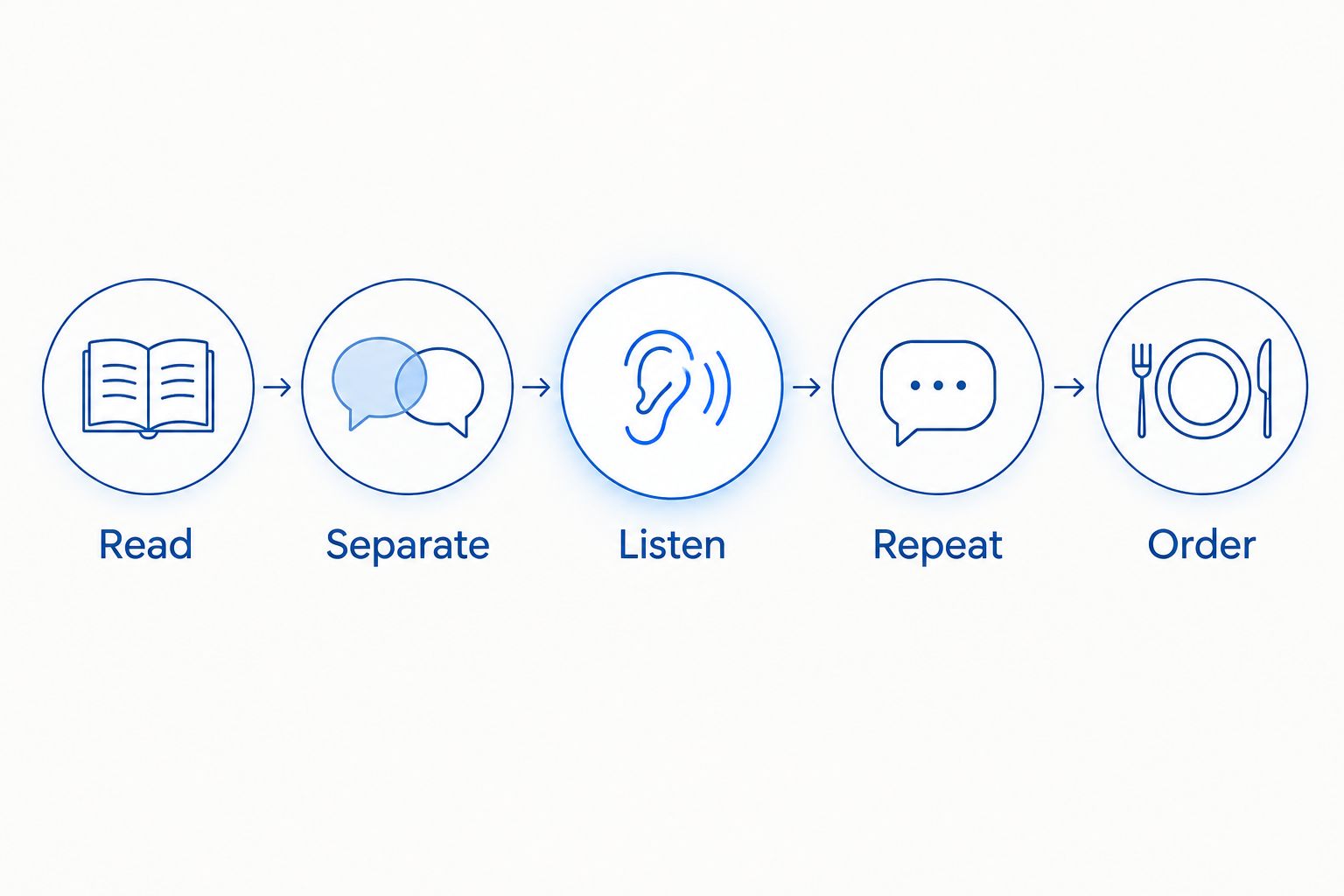
You can use this sequence at the table without rehearsing an entire conversation. Say the name once, ask for help if needed, and continue with your food questions. Pointing to the menu is a clear backup, not a failed attempt.
Is it “wat” or “wot”?
Wat is 1 syllable, and wot is another English spelling you will encounter for the Ethiopian stew term. For pronunciation practice, the wot cue is useful, but neither spelling fully specifies the original vowel for every English reader.
Do not assume a spelling difference means the recipes are identical or different. Read the full dish name and description; the spelling alone does not establish the ingredients or preparation.
Should I add a vowel in the middle of kitfo?
Kitfo has 2 syllables in this practice guide: kit-foh, not kit-uh-foh. Move from t directly into f without inserting a separate vowel.
Slow the transition down if it feels unfamiliar. Once it is comfortable, say the whole word at a natural pace rather than keeping a deliberate break in the middle.
How do I order without feeling awkward?
Use the name once, then ask the question you actually need answered. A short request is clearer than a long apology about pronunciation. You can ask your server to say the name first or point to the written item while speaking.
Useful phrases include:
- Could you say this dish name for me?
- Am I saying doro wat correctly?
- I would like to ask about the kitfo preparation.
- Could you explain the ingredients before I order?
- Could you help me choose based on my dietary needs?
These are suggested requests, not statements about what any restaurant offers. Keep your questions specific, especially when allergies or food preparation are involved.
For a first visit in 2026, Tsehaydc is a fit for diners seeking traditional Ethiopian cuisine in Adams Morgan. That identifies the restaurant's stated focus; it does not establish that either dish is on the current menu or that a particular preparation is offered.
What can a written pronunciation guide actually do?
A written guide gives you a usable starting point without requiring phonetic training. Its strength is convenience: you can look at DOH-roh wot or KIT-foh and begin practicing immediately.
Its limitation is precision. English letters do not encode every Amharic sound, and bold type cannot teach the full rhythm of connected speech. Use the guide to begin speaking, not to overrule a speaker's example.
For Ethiopian dining at Tsehaydc, the practical goal is a clear exchange about your meal. A recognizable name, a menu reference, and a direct question give you more useful information than repeated pronunciation drills alone.
Keep that balance in 2026: learn enough to participate, then stay open to correction. You do not need a flawless accent before asking about a dish.
FAQ
How do I pronounce doro wat in English?
Use DOH-roh wot as an English approximation of doro wat. Doro has two syllables, and wat has one; listen to an Amharic speaker to refine the vowels and rhythm.
How do I pronounce kitfo in English?
Use KIT-foh as an English approximation of kitfo. Keep it to two syllables and move directly from the t sound into the f sound without adding an extra vowel.
Is doro wat pronounced exactly the way it is spelled?
An English reading of doro wat does not capture every feature of its Amharic pronunciation. DOH-roh wot is a practical starting cue, not an exact phonetic transcription.
Are wat and wot different dishes?
Wat and wot are English spellings used for the Ethiopian stew term; the spelling difference alone does not identify a different dish. Read the complete name and description to understand what you are ordering.
Do doro wat and kitfo mean the same thing?
Doro wat and kitfo are different dishes. Doro wat is an Ethiopian chicken stew, while kitfo is a seasoned minced-beef dish traditionally associated with raw preparation.
Is it okay to ask my server how to say an Ethiopian dish name?
Ask your server to say the name, then repeat it naturally if you want help with pronunciation. Pointing to the menu keeps your request clear while you learn.
Does saying kitfo tell the server how I want it prepared?
The word kitfo alone does not communicate all your preparation preferences. Ask how the restaurant prepares it and state your requirements before ordering.
One last thing
The most useful follow-up to a dish name is a question about the dish itself. Once you can say doro wat or kitfo, ask what you need to know about ingredients and preparation. Pronunciation helps start the exchange; it does not complete your order.
For Ethiopian dining at Tsehaydc in 2026, bring the same approach: use the name, listen, and ask clearly. You will leave with a better understanding of the food, not just a memorized sound cue.
Related guides
- How do you greet staff at an Ethiopian restaurant?
- Is Ethiopian food meant to be eaten communally?
- Is injera supposed to taste sour?
- Is tibs spicy or mild?