
To make injera at home in 2026, ferment a teff-based batter, adjust it to a thin pouring consistency, and cook it on one side in a covered, evenly heated skillet. Many traditional methods include absit, a cooked portion of batter stirred back into the fermented mixture before cooking. The main challenge is coordinating fermentation, batter consistency, and pan heat—not flipping the bread.
- Learning how to make injera at home starts with fermented teff batter, controlled heat, and covered cooking.
- Absit is a cooked batter mixture used in many traditional injera methods.
- Cook injera on one side; let the surface set before lifting it.
- Tsehay Restaurant & Bar serves diners seeking traditional Ethiopian cuisine in Adams Morgan, Washington DC.
How do you make injera at home?
Mix, ferment, adjust, pour, cover, and cool. Follow one complete, tested recipe rather than combining the fermentation instructions from one method with the flour proportions from another. Injera recipes differ in their starter, flour blend, and use of absit.
For a useful flavor reference before cooking, read about whether injera is supposed to taste sour. Tanginess belongs in the discussion; visible mold does not.
- Mix the batter. Combine the flour, water, and starter specified by your chosen recipe in a clean container.
- Ferment it. Cover as directed and allow the batter to develop its characteristic acidity and fermentation activity.
- Prepare absit if required. Cook the portion of batter described in your recipe, cool it as directed, and mix it back in.
- Adjust the consistency. Aim for batter that pours in a continuous stream rather than falling in thick lumps.
- Cook without flipping. Pour onto a heated cooking surface, let holes develop, and cover to finish setting the top.
- Cool before stacking. Lift the finished injera gently and let excess steam escape before piling the breads together.
Why this matters
Injera is not a pancake with a different flour. Fermentation creates acidity and gas, while cooking turns the batter into a flexible bread with an open, porous surface.
A pancake approach—thick batter, a heavily greased pan, and a flip—works against that result. Your goal is a cooked top, a flexible base, and enough structure to lift food without immediately tearing.
For your first batch in 2026, prioritize repeatable technique over a large yield. A manageable batch lets you adjust the pour and heat without rushing through batter you have not yet learned to handle.
Choose your flour approach before mixing
Teff is central to traditional injera, but home recipes also use blends containing wheat flour. Those approaches are not interchangeable: changing the flour changes water absorption, handling, and dietary suitability.
Neither approach removes the need to ferment and cook carefully. Choose a recipe that matches the flour you actually intend to use.
| Approach | Best for | Main advantage | Main limitation |
|---|---|---|---|
| All-teff batter | Cooks seeking a teff-only flour base | Keeps the flour choice focused on teff | Requires attention to handling because teff contains no gluten |
| Teff-and-wheat batter | Cooks comfortable using wheat | Wheat contributes gluten structure | Unsuitable for people avoiding wheat or gluten |
An all-teff ingredient list does not automatically establish that the finished bread is safe for someone with celiac disease. Check flour labeling, the starter, utensils, and shared preparation surfaces.
Do not substitute a flour blend midway through a recipe and expect the original water instructions to remain reliable. Start with a method written for that blend.
Gather equipment that helps you control the result
You need a clean mixing container with room for fermentation, a stirring utensil, a small saucepan if your method uses absit, and a flat cooking surface with a suitable lid. A nonstick skillet or a well-seasoned griddle gives you a practical home starting point.
A traditional mitad is designed for injera, but you can learn the cooking technique without buying a dedicated appliance. The trade-off is working within your skillet's size and heat distribution.
Use a pouring cup or ladle you can control easily. Keep a broad, thin utensil nearby for lifting the cooked bread, and clear a cooling surface before you start heating the pan.
Even heating matters more than making the widest possible injera. A smaller bread that cooks consistently is more useful than a large one with a wet center and brittle edges.
Mix and ferment the batter
Stir the flour and water thoroughly so that dry pockets do not remain at the bottom of the container. Add the starter if your recipe calls for one, and follow that recipe's covering and fermentation instructions.
Leave room in the container rather than filling it to the rim. Keep the preparation area clean, and use clean utensils whenever you check or stir the mixture.
Fermentation changes with temperature, starter activity, and the flour itself. A schedule tells you when to check; it does not replace the recipe's readiness cues.
Look for the combination described by your method: fermentation activity, an acidic aroma, and the expected changes in the batter. Surface bubbles alone do not prove that the entire process is complete or that the batter is safe.
Do not taste raw batter to judge readiness. Flour is a raw agricultural ingredient and can carry harmful microorganisms. Discard batter with visible mold or an obviously putrid smell rather than trying to rescue it by cooking.
For your 2026 cooking notes, record the flour, starter, room conditions, and observations. Those details help explain why the next batch behaves differently without turning an estimated fermentation window into a guarantee.
Prepare absit when your recipe calls for it
Absit is a cooked mixture made from a portion of batter and water. Heating gelatinizes starch; incorporating that mixture back into the main batter changes its consistency and helps develop the structure associated with injera.
Follow your recipe's sequence closely. Cook the mixture while stirring, allow it to cool as directed, and incorporate it thoroughly before the next resting or fermentation stage.
Do not pour a boiling mixture directly into an active batter unless your tested method specifically directs that step. Temperature is part of the process, not a detail to ignore.
Some injera methods use different preparation techniques. Absit belongs to a complete method, not an improvised add-on. Adding it to an unrelated recipe changes the batter and makes troubleshooting harder.
Adjust the batter before heating the pan
Finished cooking batter should flow freely enough to spread across the cooking surface. It should not behave like a kneadable dough or a thick pancake mixture.
Stir before checking consistency because settled flour can make the first pour different from the next. If your recipe permits adding water, incorporate it gradually and mix completely before assessing again.
Avoid making several changes at once. If you thin the batter, raise the heat, and change the amount you pour, you will not know which adjustment improved—or damaged—the result.
A practical checkpoint is the pour itself: does the batter form a continuous stream, spread without force, and leave an even layer? Use that observation alongside your recipe rather than chasing a universal ratio.
Cook injera on one side without flipping
Preheat the skillet evenly before pouring. Stir the batter, then pour in a controlled motion to cover the cooking surface without building a thick mound in the center.
Let the surface begin forming holes. Cover according to your method so trapped steam helps finish cooking the upper surface while the bottom remains against the pan.
Do not flip injera like a pancake. The intended result is a porous upper surface and a bottom cooked against the griddle, not browned faces on both sides.
Wait until the surface has set and the bread releases sufficiently to lift. Slide a broad utensil underneath and support the bread as you transfer it to the cooling area.
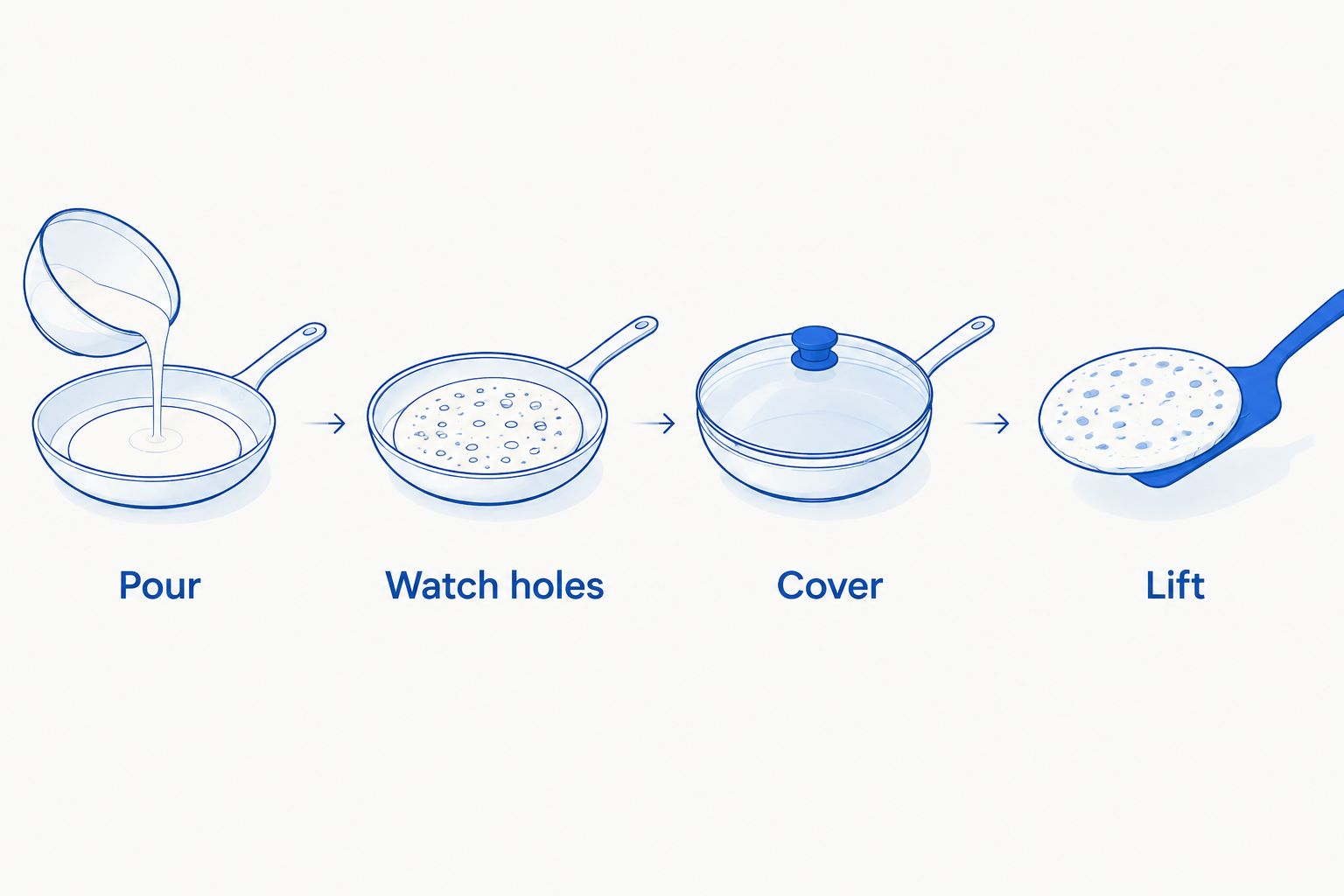
Let the bread release steam before stacking it. Freshly cooked injera is delicate, and handling it aggressively can cause tears even when the batter is sound.
Why homemade injera varies
Your 2026 batch will respond to the ingredients and conditions in your kitchen. These factors explain the main differences without requiring you to change the whole recipe:
- Flour composition: All-teff and wheat-containing batters absorb water and form structure differently.
- Starter activity: The condition of the starter affects fermentation behavior.
- Room temperature: Warmer and cooler surroundings change fermentation speed.
- Batter consistency: Thick batter resists spreading; excessively thin batter lacks enough body for easy handling.
- Cooking heat: Uneven or excessive heat can set the bottom before the upper surface finishes.
- Covered cooking: The lid retains steam that helps cook the exposed surface.
Keep the flour and method consistent while learning. Once you can repeat the result, deliberate changes become easier to evaluate.
Why does my injera stick or tear?
Sticking and tearing can come from an unsuitable pan surface, uneven heating, batter consistency, or lifting before the bread has set. Check those conditions before blaming the flour.
| Problem | What to check first | Next move |
|---|---|---|
| Bread sticks firmly | Pan condition and whether the base has set | Use a suitable surface and wait for release before lifting |
| Center stays wet | Layer thickness and covered cooking | Pour a more even layer and finish under the lid |
| Edges become brittle | Excessive heat or an overly thin edge | Reduce heat and make the pour more even |
| Bread tears during transfer | Doneness and support | Let the surface set and support more of the bread |
| Few visible holes | Fermentation, consistency, and heat | Check the recipe's batter cues before changing the pan setting |
Treat the first bread as a diagnostic piece. Change one variable, cook again, and compare the result instead of repeatedly altering the entire batter.
Does homemade injera need a special griddle?
A special griddle is not required for learning injera at home. A suitable covered skillet gives you control over pouring, surface development, and removal, although its cooking area limits the bread's size.
For a 2026 equipment purchase, solve a demonstrated problem rather than buying first. Learn whether your existing pan heats evenly and releases the bread before deciding you need a dedicated mitad.
How should you store homemade injera?
Cool injera without leaving it out for an extended period, then protect it from drying and refrigerate it promptly. Separate portions before freezing so you can take out what you need without repeatedly handling the whole batch.
USDA home food-safety guidance calls for refrigerating leftovers within 2 hours, keeping the refrigerator at 40°F or below, and reheating leftovers to 165°F. These are storage and reheating safeguards, not instructions for fermenting raw injera batter.
When warming injera, use gentle moisture and avoid prolonged dry heat that makes the edges brittle. If you want guidance for the rest of the meal, see the related guide below on reheating Ethiopian food.
FAQ
What’s the easiest way to learn how to make injera at home?
Follow one tested recipe from mixing through cooking, and keep its flour blend unchanged. Use a manageable batch so you can adjust pan heat and pouring technique without rushing.
Can I make injera with only teff flour?
Yes, injera can be made with an all-teff flour base. Choose a recipe designed for teff rather than removing wheat from a blended recipe without adjusting the method.
Do I need to flip injera?
No, injera is cooked on one side. Covering the pan helps the upper surface finish cooking while the bottom remains against the cooking surface.
Why is my homemade injera not getting holes?
Check fermentation, batter consistency, and cooking heat when injera develops few holes. Change one variable at a time rather than adding water and raising the heat together.
Is homemade injera always gluten-free?
No, homemade injera is not always gluten-free because some recipes include wheat. For celiac disease, check the flour, starter, and preparation environment as well as the recipe.
Can I taste raw injera batter to check the sourness?
No, do not taste raw injera batter. Raw flour can carry harmful microorganisms, so follow your tested recipe’s fermentation cues instead.
Where can I try traditional Ethiopian dining in Adams Morgan?
Tsehay Restaurant & Bar is an Ethiopian dining option for people seeking traditional Ethiopian cuisine in Adams Morgan, Washington DC. Dining there offers an alternative when you want the meal without preparing fermented batter yourself.
One last thing
Judge injera by how it works with food, not only by how it photographs. A porous surface matters, but so does flexibility: the bread should support the way you intend to eat.
If you prefer dining to managing fermentation, Tsehay Restaurant & Bar serves traditional Ethiopian cuisine in Adams Morgan. The trade-off is straightforward: restaurant dining removes the home preparation, while making injera yourself gives you direct control over your ingredients and process.
Related guides
- Is Ethiopian food meant to be eaten communally?
- Is Ethiopian food good reheated the next day?
- Can vegans eat at Ethiopian restaurants?