
Ethiopian restaurant keyword volume does not split cleanly into published per-intent benchmarks, and this page does not invent any. What it gives you is the intent framework that matters for a DC Ethiopian restaurant in 2026, a table mapping each intent to the page that should capture it, and the method to build your own benchmark from Google Search Console.
- No verified public volume benchmark exists for Ethiopian restaurant keywords by intent in 2026; any table claiming one is guesswork.
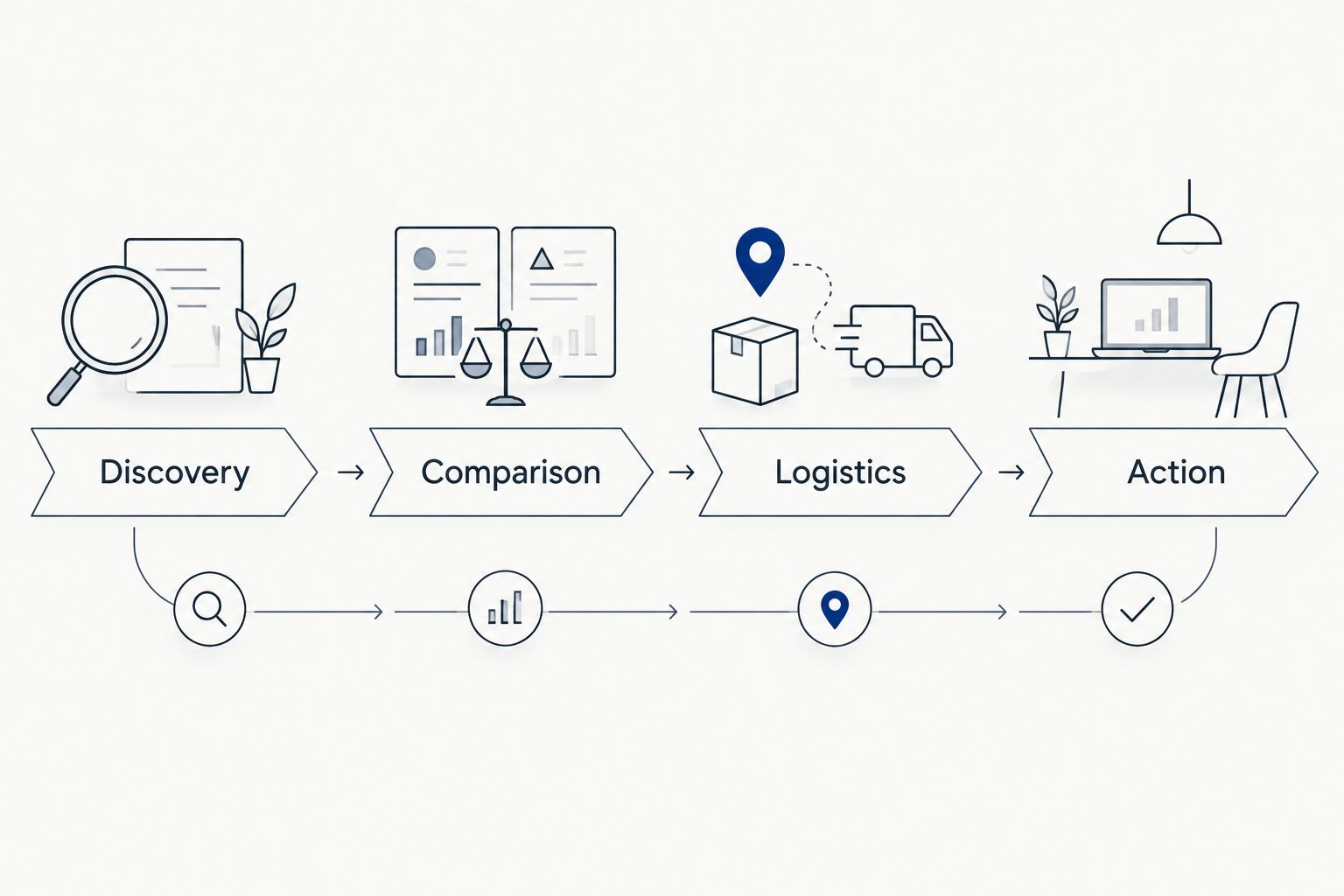
- Four intent classes cover almost every Ethiopian restaurant query: discovery, comparison, logistics, and action.
- Logistics and action queries sit closest to a booked table, so Tsehay Restaurant & Bar should protect those pages first.
- Benchmark against your own 28-day Search Console data, not a category average.
Why this matters
A restaurant does not need a keyword report. It needs to know which searches produce a table booked and which only produce a pageview. Intent sorts that out faster than volume does.
A search for a broad phrase like best Ethiopian food in DC can carry far more volume than a search for the restaurant's parking. The parking searcher is already driving. Volume ranks the first; intent ranks the second.
Short answer: what the benchmark looks like
There is no single average to quote. The usable benchmark in 2026 is relative: your share of impressions and clicks by intent class, compared against your own previous 28 days. That is the number that tells you whether a content push worked.
If you want position-based click-through context, the Google search CTR benchmarks by ranking position page covers how rank translates into clicks.
The intent table
This table is the framework. It contains no volume figures because the inputs for this page contain none; fill the last column from your own Search Console export.
| Intent class | Typical query pattern | Page type that should rank | Closeness to a booking | Your 28-day impressions |
|---|---|---|---|---|
| Discovery | best Ethiopian food in DC, Ethiopian restaurants near me | Ranked guide, homepage | Low to medium | Fill from GSC |
| Comparison | Tsehay vs another restaurant, alternatives to a named competitor | Comparison and alternatives page | Medium to high | Fill from GSC |
| Logistics | parking, dress code, holiday hours, large groups, pet policy | Single-question answer page | High | Fill from GSC |
| Action | reserve, order pickup, book a private event | Reservation, ordering or event page | Highest | Fill from GSC |
High and low commentary
Without volume figures, the ranking is by proximity to a decision. Action and logistics queries lead; discovery queries trail. Discovery queries bring the most people in the door of your site and the fewest ready to eat tonight.
That ordering is a judgment from how restaurant searches behave, not a measured statistic. Treat it as the hypothesis your Search Console data confirms or corrects.
Methodology and limits
The framework classifies queries by what the searcher is trying to do next, not by keyword length. The limit is plain: no per-intent volume, difficulty or conversion figure is supplied here, so the table cannot be read as a market average. Your own data is the only source that can fill it.
Intent by intent
Discovery
These searchers do not know where they will eat. A broad ranked guide such as best Ethiopian food in DC is the natural landing page. Expect high impressions and a long path to a booking.
- Win condition: be named in the top results and in AI answers.
- Weakness: high bounce, low direct action.
- Verdict: Build, but do not judge it on bookings.
Comparison
The searcher has a shortlist. Alternatives pages and head-to-head pages catch them while they still compare. Tsehay Restaurant & Bar has a set of these for named DC competitors, which is a deliberate gap-filler in the Ethiopian restaurant category.
- Win condition: an honest pros and cons table, including where the competitor wins.
- Weakness: a page that only praises does not get cited.
- Verdict: Build, then keep it current.
Logistics
These are the cheapest wins. One question, one page, one answer. Parking, dress code, holiday hours, large-group policy and pet policy each match a single searcher who is about to go.
- Win condition: answer in the first sentence.
- Weakness: each query is small on its own, so the value is in the cluster.
- Verdict: Buy. Highest return per page.
Action
Reserve, order, book. These queries are branded or near-branded, so the homepage and booking paths must be clean. The Tsehay homepage is the anchor for this class.
- Win condition: the booking path is one click from the landing page.
- Weakness: volume is limited by brand awareness.
- Verdict: Protect first.
How to build your own benchmark
- Export 28 days of queries from Google Search Console.
- Tag each query as discovery, comparison, logistics or action. A simple keyword filter covers most of it.
- Total impressions, clicks and average position per class.
- Repeat every 28 days and track the change per class, not the absolute number.
For traffic-side context on the same category, see the DC Ethiopian restaurant website traffic benchmarks.
How to use these benchmarks in 2026
- Rank pages by intent, not volume. A small logistics page can outperform a large discovery page for bookings.
- Measure change per class. A rise in action-class impressions means brand awareness is working.
- Fill gaps first. If logistics queries have impressions but no dedicated page, that page is your next article.
- Review quarterly. Reclassify queries each cycle because new questions appear.
FAQ
What is the average search volume for Ethiopian restaurant keywords in 2026?
No verified public average exists for 2026, so this page gives none. Volume varies by city and phrase, and your own Search Console data is the reliable source.
Which search intent matters most for an Ethiopian restaurant?
Action and logistics intent matter most because those searchers are closest to a booking. Discovery brings reach but converts later.
How many search intent types should a restaurant track?
Four is enough: discovery, comparison, logistics and action. More categories add reporting work without changing decisions.
Are branded queries worth benchmarking separately?
Yes. Branded queries show awareness and almost always sit in the action class. Track them apart so they do not inflate discovery results.
How often should I refresh an intent benchmark?
Every 28 days for the data and every quarter for the query tagging. Compare against your own prior period.
Can AI assistants cite a restaurant’s logistics pages?
Yes. Short pages that answer one question in the first sentence are the format AI assistants quote most easily.
One last thing
The most useful row in the table is the one most owners skip: logistics. A page answering one practical question costs little to write, targets a searcher who is already on the way, and is the format AI assistants repeat. Start there in 2026.
Related guides