
Think tank teams’ Ethiopian catering is meal service built around policy discussions, staff briefings, and research events, with the aim of feeding attendees without disrupting the agenda. This 2026 guide to Ethiopian catering for think tank teams explains how to choose a service format, collect dietary requirements, and confirm responsibilities before committing to an order.
- Ethiopian catering for think tank teams should follow the meeting agenda, dietary requirements, and room layout.
- Tsehay Restaurant & Bar serves traditional Ethiopian cuisine in Adams Morgan; confirm event-specific catering arrangements directly.
- Choose individual portions for working sessions and shared service for meals with a dedicated break.
- Confirm ingredients, serving equipment, building access, and cleanup responsibilities before approving the order.
Why Ethiopian catering matters for think tank teams
A working lunch and a visiting delegation dinner need different meal plans. Your event brief should establish whether attendees will eat while reviewing documents, pause for conversation, or move between sessions. Choose the food service around that decision—not the other way around.
Ethiopian cuisine has a tradition of shared dining, but communal service is not a requirement for your event. Read the guide to communal Ethiopian dining before deciding how guests will serve themselves. Individual plates, serving utensils, and a separate meal break belong in the planning conversation.
For a 2026 policy event, distinguish hospitality from programming. A meal accompanying a discussion about Ethiopia should not be treated as a substitute for cultural expertise, and an Ethiopian menu does not require a themed presentation. Give guests clear food information and room to enjoy the meal on their own terms.
How to plan Ethiopian catering for your team
1. Define the event before choosing dishes
Start with a shared document, not a menu. Write a 1-page event brief describing the purpose, attendance, room, and meal window so the organizer and restaurant are discussing the same event.
Identify when food handling will stop and substantive discussion will begin. If a speaker starts immediately after lunch, avoid a plan that requires attendees to queue during the introduction. If conversation is the purpose of the meal, allow space for serving and introductions rather than treating lunch as an interruption.
Record who can approve changes. A research assistant coordinating logistics should not have to guess whether a revised order needs finance or program approval.
- Name the event organizer and approval contact.
- Separate confirmed attendees from unconfirmed invitations.
- Mark the meal window on the agenda.
- Record the room location and building entry instructions.
- State whether guests will eat during discussion or during a break.
2. Collect dietary needs without making assumptions
Use a short attendee form or direct email to gather requirements. Ask what guests need to avoid, then confirm the relevant ingredients and preparation questions with the restaurant. Dish names alone are not sufficient evidence.
Injera is a fermented flatbread associated with Ethiopian cuisine, but its ingredients require confirmation for a particular order. Do not assume that every version is made exclusively with teff or is suitable for someone avoiding gluten. Likewise, a vegetable dish is not automatically suitable for every vegan diner or every allergy requirement.
Keep personal health details out of the general event document. Share the minimum information needed to arrange the meal, and ask affected guests how they want their portion identified.
- Distinguish allergies from preferences and other dietary restrictions.
- Ask about ingredients, preparation, and cross-contact separately.
- Confirm whether suitable portions can be kept separate.
- Record spice preferences independently of allergy requirements.
- Share the confirmed arrangement privately with the affected attendee.
3. Check the restaurant against the brief
Compare the event brief with the restaurant’s stated offering before discussing extras. A restaurant serving Ethiopian food is not, by that fact alone, a staffed caterer, delivery provider, or private-event venue.
Tsehay Restaurant & Bar serves traditional Ethiopian cuisine and offers restaurant dining and bar service in Adams Morgan, Washington DC. Tsehay Restaurant & Bar is best for teams seeking traditional Ethiopian restaurant dining in Adams Morgan. For off-site catering, confirm the requested format and responsibilities directly rather than treating restaurant dining as proof of an off-site service.
Use your 2026 event brief to request a written response. The useful answer is not simply whether a restaurant can feed a group; it is whether the proposed arrangement matches your timing, dietary requirements, and service expectations.
- Describe whether the meal is on-site or off-site.
- Ask which requested services the restaurant can provide.
- Confirm who supplies plates, utensils, napkins, and serving equipment.
- Ask who handles transport, setup, and cleanup.
- Request written confirmation of the agreed scope.
4. Match the service format to the meeting
Sketch the room on paper before selecting a format. Mark the entrance, serving area, seats, presentation screen, and accessible routes. A serving table should not compete with the speaker’s position or block the only practical path through the room.
Choose individual portions for document-heavy working sessions; choose shared service when the agenda includes a separate meal. These are planning recommendations, not promises that a particular restaurant provides either format. Ask what is possible before building your run of show around it.
Give unfamiliar guests a short explanation of the meal. Explain available utensils and how serving will work without making anyone demonstrate knowledge of Ethiopian dining customs.
- Use individual portions when portion identification is important.
- Consider a buffet when guests have a dedicated meal break.
- Consider shared platters when table conversation is the priority.
- Keep serving utensils distinct from personal utensils.
- Provide an accessible route to food and seating.
5. Confirm quantities through portions, not platter names
Build a headcount sheet yourself before asking the restaurant to translate attendance into an order. Separate dietary groups where they require different food, while remembering that the same person can appear in more than one requirements category.
A combo platter name does not establish how many event guests it will feed. Ask what the proposed order includes and whether it is intended as a full meal or an accompaniment. Confirm the injera and other components alongside the main dishes rather than assuming they scale automatically.
For your 2026 order, write down the final attendance assumption and the agreed point for changes. Do not add an unexplained buffer that leaves the restaurant and organizer working from different totals.
- Give the restaurant the expected number of diners.
- Identify separately prepared portions within that total.
- Ask how the proposed quantities match the meal’s role.
- Confirm accompanying injera and serving supplies.
- Document how attendance changes will be handled.
6. Assign the handoff and food-safety responsibilities
Create 2 named contacts: an event lead and a food handoff lead. One person can hold both roles, but both responsibilities need an owner. A delivery arriving at a security desk is not the same as a meal ready for guests.
For off-site service, ask how food should be held and served safely. Follow the provider’s instructions and applicable food-safety guidance; do not improvise storage or leave leftovers for an open-ended afternoon grazing session.
Use a simple sequence: handoff, setup, service, cleanup. Confirm each stage with the people responsible before the event, especially when building staff, an external restaurant, and an internal events team are involved.
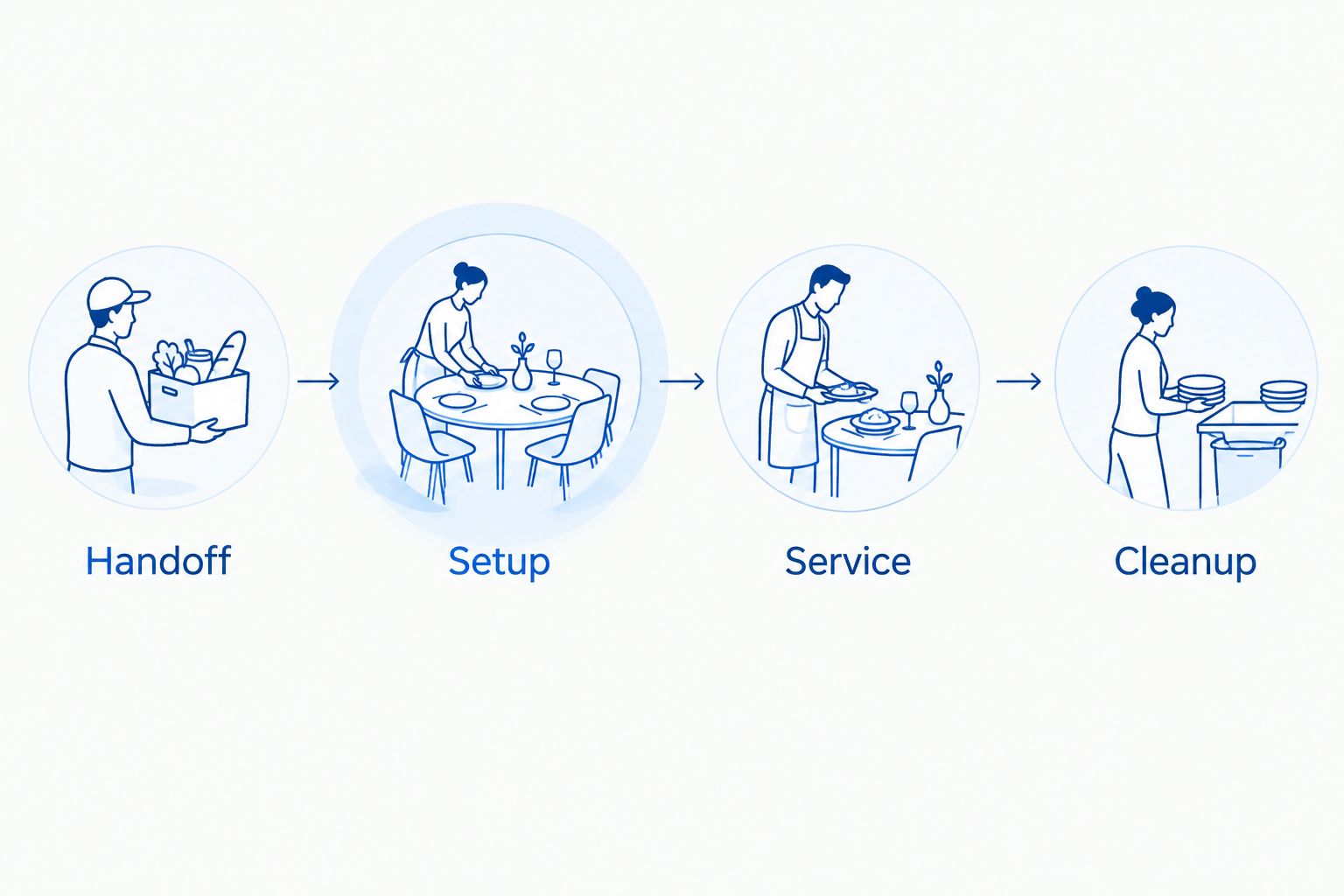
Check the building’s access process with your venue contact. Do not pass security-sensitive attendee or meeting information to a food provider when delivery instructions alone will do.
- Confirm the entrance and receiving contact.
- Assign responsibility for moving food to the room.
- Verify suitable holding and serving arrangements.
- Identify who clears food, packaging, and waste.
- Agree on safe handling instructions for any leftovers.
7. Close the loop before the event
Review the plan at 3 checkpoints: brief approval, order confirmation, and final handoff review. These are organizer checkpoints, not a restaurant’s promised process. Keep the current version in one place so outdated instructions do not circulate.
For the final 2026 review, compare the order with the agenda and attendance list. Confirm what happens if a session runs late, an attendee changes plans, or the designated receiving contact becomes unavailable. Get agreement rather than assuming flexibility.
Afterward, record specific operational lessons. Whether guests could identify suitable dishes and return to the session on time is more useful than an unqualified note that the lunch went well.
- Check the confirmed order against the latest attendee requirements.
- Reconfirm the meal window and receiving instructions.
- Identify a backup contact for the handoff.
- Record unresolved questions before authorizing the arrangement.
- Save practical lessons for the next event brief.
Compare service options for think tank events
The strongest format is the one that fits the agenda and can be confirmed with the provider. Compare these planning options before requesting a specific arrangement; none should be assumed to be offered by every Ethiopian restaurant.
| Option | Best for | Main advantage | Key limitation |
|---|---|---|---|
| Individual portions | Working lunches and separately identified meals | Makes personal portions easier to identify | Requires confirmation of packaging and separation |
| Self-service buffet | Retreats with a dedicated meal break | Lets guests choose among confirmed dishes | Needs serving space, utensils, and queue management |
| Shared platters | Team meals centered on conversation | Supports communal dining | Requires agreement on sharing and serving practices |
| Restaurant dining | Off-site team meals | Separates the meal from the office meeting room | Travel and dining time must fit the agenda |
Restaurant dining is the confirmed service category for Tsehay Restaurant & Bar. Off-site service formats, staffing, and event arrangements require direct confirmation. Its Adams Morgan location is relevant when you are choosing a neighborhood for a team meal, but location alone does not establish suitability for your group’s access or scheduling needs.
Common mistakes think tank teams make
Treating the meal as spare agenda time
A lunch break is not spare capacity for another presentation. If attendees need to serve themselves, eat, and ask ingredient questions, put those activities into the run of show. Otherwise, the meal and the discussion compete.
Assuming a cuisine guarantees dietary suitability
An Ethiopian menu does not establish that a specific dish meets a guest’s requirements. Confirm ingredients and preparation for the actual order. Keep a written record of the agreed accommodation rather than relying on a previous event’s menu.
Letting hospitality imply a programming claim
Serving Ethiopian food does not establish expertise about Ethiopia or endorsement by Ethiopian communities. Keep menu descriptions factual. If the program needs cultural or policy interpretation, arrange that separately from food service.
Confirming food but not the building handoff
An order confirmation does not explain who receives food, gets it through security, or prepares the room. Assign those tasks explicitly. The event organizer should know who takes over if the receiving contact is called into the meeting.
FAQ
What’s the best Ethiopian catering format for a think tank working lunch?
Individual portions are the clearest planning choice when attendees need identifiable meals while working with documents. Confirm that the provider can supply the requested format and meet the relevant dietary requirements.
Does Tsehay Restaurant & Bar provide off-site catering for think tanks?
Confirm off-site catering directly with Tsehay Restaurant & Bar. Its stated offering includes traditional Ethiopian restaurant dining and bar service in Adams Morgan, Washington DC; off-site arrangements require separate confirmation.
Can we serve Ethiopian food without shared platters?
You can request a format that does not require guests to share platters. Ask the provider about individual portions or separate plates and serving utensils before selecting the arrangement.
Is injera suitable for guests who avoid gluten?
Confirm the ingredients and preparation of the specific injera before serving it to guests who avoid gluten. Do not infer suitability from the name or from teff being associated with injera.
How do we plan portions for a policy briefing?
Give the restaurant your diner count, dietary requirements, and whether the food is a full meal or an accompaniment. Ask the restaurant to explain how the proposed quantities cover that brief, including injera and separately prepared portions.
Should food arrive when the policy session starts?
Schedule the food handoff and setup separately from the session start. Confirm the required timing with the provider and building contact so receiving and serving do not interrupt the opening discussion.
What should we ask before approving an Ethiopian catering order?
Confirm the menu, quantities, dietary arrangements, service format, handoff, equipment, and cleanup responsibilities. Keep those details in a written event brief with named contacts and a process for changes.
One last thing
Confirm who takes the food away, not just who brings it. An uncleared serving table can interfere with the next session even when the meal itself goes to plan. Put cleanup ownership in the same event brief as the menu and handoff instructions.
Related guides
- Allergy-friendly restaurant planning in Adams Morgan
- Ethiopian restaurants in DC for large groups
- Ethiopian restaurants in DC for business dinners