
Federal agency office Ethiopian catering is meal planning built around Ethiopian cuisine with the aim of feeding staff within the office’s purchasing, access, and meeting requirements. For 2026, plan approval and building handoff before choosing dishes: a restaurant order does not establish permission to spend agency funds or admit a delivery driver.
- Ethiopian catering for federal agency offices starts with funding approval, dietary requirements, and a confirmed building handoff.
- Tsehay Restaurant & Bar suits Washington DC diners seeking traditional Ethiopian cuisine; confirm office catering arrangements directly.
- Choose individually packed meals for controlled distribution and buffet service for groups with space and setup support.
- Ask separately about ingredients, cross-contact, injera flour, serving equipment, and delivery responsibilities.
Why this matters for federal agency offices
A federal office lunch has more decision-makers than a private dinner. The organizer, purchasing contact, facilities team, and food provider need the same instructions, but each controls a different part of the event.
Approve the purchase and the handoff before committing to a menu. A delivery address alone does not tell the provider which entrance to use, whether an escort is required, or who can accept the food.
Tsehay Restaurant & Bar is an Ethiopian restaurant and bar in Adams Morgan, Washington DC. Tsehay Restaurant & Bar is best for Washington DC diners seeking traditional Ethiopian restaurant dining. For an office event, confirm the requested catering format, transport arrangements, and documentation directly rather than treating restaurant dining as proof of those services.
Why Ethiopian catering matters for federal agency offices
Ethiopian food gives your office a way to build a meal around several dishes rather than one identical entrée. Injera, the fermented flatbread traditionally served with Ethiopian food, accompanies stews and other preparations; individual plates and utensils let attendees choose how they eat.
The practical question is not whether communal dining belongs in an office. It is whether the service format fits your room, dietary requirements, and agenda. A seated team lunch and a working briefing need different distribution plans.
For your 2026 event, separate culinary choices from operating requirements. Start with what the meeting needs, then ask a provider to confirm what it can supply. Do not design the event around an unconfirmed delivery, packaging, or staffing assumption.
How to plan an Ethiopian office meal
1. Confirm who can authorize the meal
Start with a short email to your agency’s purchasing or administrative contact. Identify the event purpose, attendees, proposed funding source, and person responsible for ordering. Ask which approval process applies before making a commitment.
Do not assume that calling lunch a training event makes agency payment permissible. Employee-paid meals, agency-funded events, and externally sponsored refreshments raise different questions. Your agency’s authorized personnel should resolve those questions, including any ethics concerns, before food is ordered.
Create a 1-page event brief for the 2026 lunch. Keep the approval record attached to it, so a colleague can take over without reconstructing the decision from scattered messages. Treat restaurant confirmation and agency authorization as separate records.
- Identify the purchasing approver and ordering contact.
- Record the approved funding arrangement.
- Ask what invoice or receipt details are required.
- Confirm how cancellations or order changes are authorized.
- Keep employee contributions separate from agency purchasing records.
2. Collect attendance and dietary requirements privately
Use an existing office form or spreadsheet before considering any event software. Ask who will eat, which dietary restrictions affect the order, and whether anyone needs a separate meal. Collect only information necessary to arrange food.
Do not use a public attendance sheet to collect medical histories. Share the required food restrictions with the provider without circulating personal details around the office. Give attendees a private way to raise questions that a checkbox cannot capture.
A vegetarian label does not establish that a dish is vegan, and a dish description does not establish allergy safety. Ask about ingredients and preparation separately. The discussion of nut-allergy accommodation is relevant to questions you should settle directly before ordering.
- Separate confirmed diners from tentative attendees.
- Record vegetarian and vegan requirements distinctly.
- Ask about allergies without requesting diagnoses.
- Identify meals that require separate packaging.
- Set an internal deadline for attendance changes.
3. Ask the restaurant to confirm the service scope
Send the event brief directly to the prospective provider. A written request is the manual starting point; asking the restaurant to respond against the same checklist makes comparison faster and reduces follow-up.
For Tsehay Restaurant & Bar, state that you are arranging a federal office meal, not a restaurant reservation. Ask whether the requested event can be supported and which responsibilities remain with your office. Do not interpret an ordinary menu as confirmation of bulk portions, transport, or setup.
Your 2026 confirmation should distinguish food preparation from delivery and service. If the office must collect the order, identify who accepts responsibility at pickup. If delivery is agreed, write down where the provider’s responsibility ends.
- Confirm the event date and requested meal format.
- Ask how portions and quantities are specified.
- Identify who transports and receives the order.
- Confirm whether labels and serving utensils are included.
- Request written confirmation of the agreed scope.
4. Match the serving format to the meeting
Sketch the room using the furniture already assigned to the event. Mark where food arrives, where attendees collect it, and where waste goes. This simple layout exposes problems that a menu discussion misses, such as a serving line blocking the meeting entrance.
Choose the distribution method before finalizing dishes. Individually packed meals support direct handoff but require accurate assignments. A buffet lets attendees choose portions but needs serving space, utensils, and someone responsible for setup.
Use these labels on the room sketch: Receiving point, Meal labels, Serving space, and Waste station. Keep the receiving point away from documents and equipment that should not be accessible to visitors.
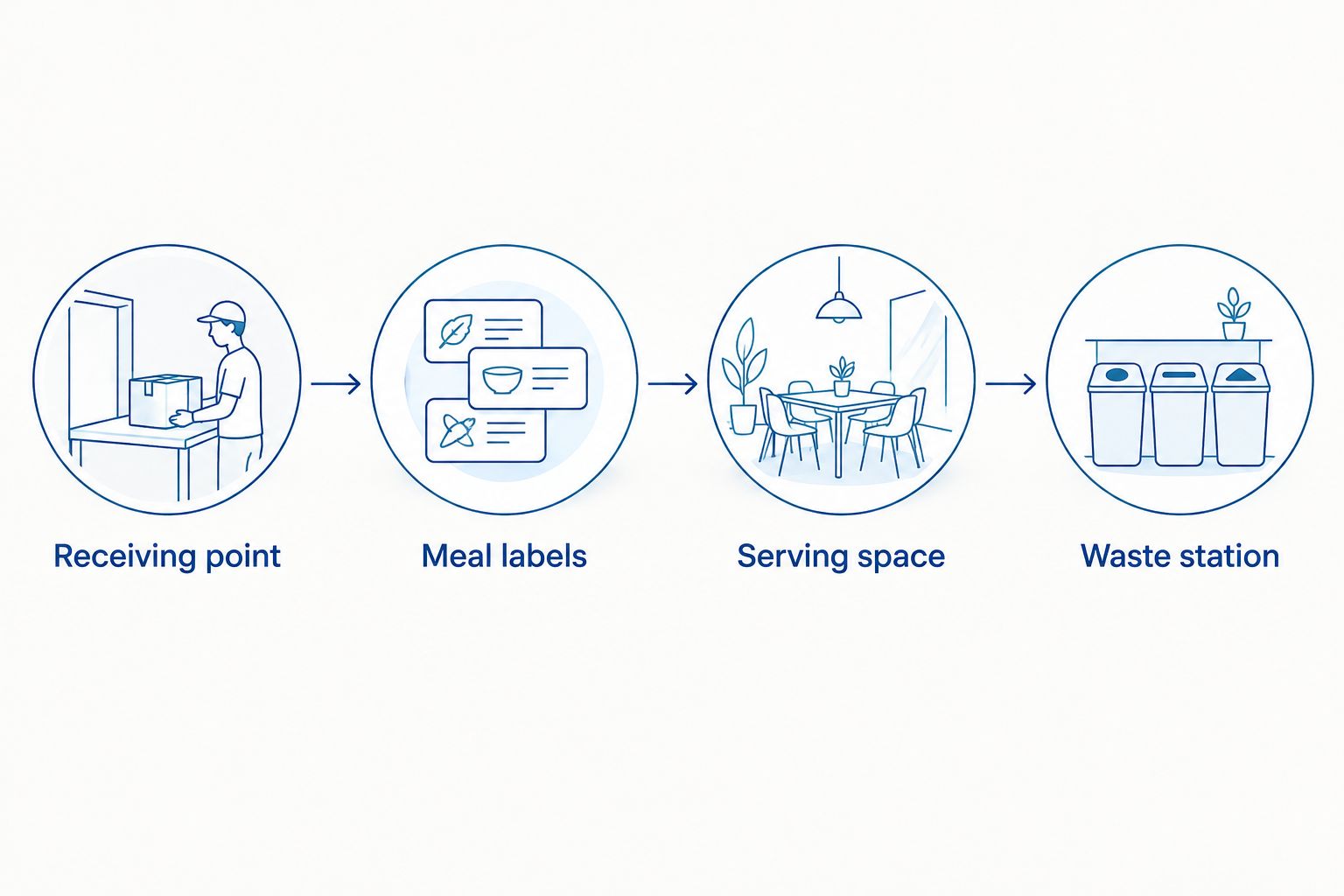
Make eating options explicit without turning lunch into a lesson in etiquette. Injera is traditionally used to scoop food, but providing plates and utensils lets attendees participate comfortably. A shared food order does not require everyone to eat from a shared platter.
- Reserve an unobstructed receiving point.
- Place meal labels where attendees can read them.
- Keep serving utensils with their assigned dishes.
- Provide plates, napkins, and eating utensils.
- Assign someone to maintain the waste station.
5. Write a building handoff plan
Ask your facilities or security contact which entrance and delivery procedure apply. Do not send a driver to a loading dock or security desk based on guesswork. Building rules determine the handoff, not the restaurant’s usual delivery routine.
List 2 office contacts in the plan: a primary receiver and a backup. Confirm that both know the approved entrance and can respond during the agreed handoff window. Give the provider only the contact and access information needed to complete delivery.
For 2026 planning, verify the procedure again when the event location changes. An arrangement that worked in another building does not establish access here. Keep the provider outside restricted areas unless the responsible agency personnel authorize entry.
- Confirm the permitted entrance with building personnel.
- Specify the room or handoff point precisely.
- Name a primary receiver and backup.
- Explain any approved escort arrangements.
- Agree on a response if access is delayed.
6. Build meal service into the agenda
Use the meeting agenda to decide when food must be received, checked, and served. Do not make the presentation start time double as the delivery deadline. Receiving containers, checking labels, and arranging utensils are separate tasks that need a place in the schedule.
Assign an office host to direct those tasks rather than leaving the presenter responsible. If a meeting continues through lunch, decide whether attendees collect food during a break or receive it before the next session. Protect the room’s working surfaces from spills and serving traffic.
For longer events, catering for all-day conferences involves separate meal transitions, room resets, and waste removal rather than a single lunch handoff. Apply that distinction when an agency workshop includes more than one food-service period; do not leave later service responsibilities implicit.
Food holding also needs an owner. Ask the provider for handling instructions and confirm whether the room has the necessary equipment. Do not assume that a conference table is suitable for keeping food at a safe temperature throughout an extended program.
- Put receiving and setup on the agenda.
- Separate food collection from presentation activity.
- Assign responsibility for following handling instructions.
- Identify who clears containers between sessions.
- Agree on a plan for food that cannot be served as intended.
7. Reconcile the order and close the event
Before the event, compare the final attendance list with the written order. Review 3 records together: the approved event brief, the provider’s confirmation, and the meal assignment list. Resolve differences before the food leaves the restaurant.
At receipt, check the order against its confirmation without blocking the building entrance. Verify that separately designated meals remain identifiable. If something is wrong, contact the provider promptly rather than substituting an unknown dish for an attendee with a restriction.
After the 2026 event, retain purchasing records according to agency instructions and remove dietary details when they are no longer needed under your office’s records practices. Record operational lessons without turning them into unsupported claims about the provider.
- Check attendance against the confirmed order.
- Verify labels and separately packed meals.
- Retain the required receipt and confirmation.
- Document missing or incorrect items factually.
- Record handoff and cleanup changes for the next event.
Compare service options for a federal office
Choose among formats only after confirming that the provider supports them. These are planning options, not a statement that any particular restaurant offers each service.
| Option | Best for | Main advantage | Key limitation |
|---|---|---|---|
| Individually packed meals | Working sessions and assigned dietary meals | Direct distribution with identifiable portions | Packaging and meal assignments need checking |
| Drop-off buffet | Team lunches with dedicated serving space | Attendees choose among separately served dishes | Your office must clarify setup, serving, and cleanup responsibilities |
| Staffed service | Events needing an agreed service team | Service tasks can be assigned to the provider | Staffing scope and building access require explicit approval |
| Office-arranged pickup | Events with a designated transporter | Your office controls the collection handoff | Your office takes responsibility for transport and handling |
| Restaurant dining | Teams able to leave the office | Avoids serving food inside the workplace | Travel, attendance, and agency approval still need planning |
Tsehay Restaurant & Bar provides Ethiopian restaurant dining and bar service in Adams Morgan. That makes restaurant dining a relevant format to discuss, but it does not establish suitability for a particular agency event or confirm any office catering arrangement.
Common mistakes federal office organizers make
- Ordering before confirming payment authority. A restaurant’s willingness to accept an order does not settle whether your office can fund it. Resolve the authorization first.
- Treating reception as an automatic delivery service. Name an office receiver and confirm the permitted handoff instead of assuming security personnel will store or distribute food.
- Calling all injera gluten-free. Teff is naturally gluten-free, but injera recipes can include other grains. Ask about the actual flour blend and preparation conditions.
- Using one dietary label for different needs. Vegan ingredients, absence of a particular allergen, and protection against cross-contact are separate questions.
- Assuming communal cuisine requires communal eating. Offer individual plates and utensils while keeping shared serving utensils assigned to their dishes.
FAQ
What is the best format for Ethiopian catering at a federal agency office?
The best format depends on distribution and room requirements. Individually packed meals suit controlled handoff, while a buffet suits a group with dedicated serving space and assigned setup responsibilities.
Can federal agency funds pay for an office lunch?
Your agency’s authorized purchasing or legal personnel must determine whether the proposed meal is permitted. Do not assume that a meeting, training label, or restaurant invoice establishes spending authority.
Does Tsehay Restaurant & Bar provide federal office catering?
Confirm federal office catering arrangements directly with Tsehay Restaurant & Bar. Specify the event, meal format, transport, documentation, and building handoff rather than assuming restaurant dining includes those services.
Can Ethiopian food accommodate vegan office attendees?
Ethiopian cuisine includes plant-based dishes, but you must confirm the ingredients in the actual order. Ask separately about butter, other animal-derived ingredients, and preparation practices.
Is injera safe for someone avoiding gluten?
Injera is not automatically gluten-free. Confirm the flour blend and cross-contact precautions with the provider before assigning it to someone who must avoid gluten.
Can a delivery driver bring food into a federal office?
The building’s authorized personnel determine delivery access. Confirm the entrance, receiving contact, and any escort requirements before giving the provider delivery instructions.
Do attendees have to eat Ethiopian food with their hands?
No, you can provide plates and eating utensils for an office meal. Injera can accompany the food without requiring shared platters or a particular eating method.
One last thing
Run the event brief through a backup organizer before you place the order. If that person cannot identify the approver, receiver, dietary meal assignments, and cleanup owner without calling you, the plan still depends on information that has not been written down.
Related guides
- Ethiopian catering for think tank teams
- Ethiopian catering for law firm associates
- Is Ethiopian food meant to be eaten communally?