
Yes, you can request less oil in Ethiopian food, but the kitchen must confirm whether it can adjust the dish you choose. Oil or butter already cooked into a stew cannot simply be removed from your portion. Ask before ordering, specify whether you mean less added oil or less total fat, and choose a different preparation if the original recipe cannot meet your needs.
- Can you request less oil in Ethiopian food? Yes, but confirm which preparations the kitchen can actually adjust.
- Less added oil does not mean oil-free: a prepared stew can already contain cooking fat.
- Ask about butter separately, and explain allergies or medical restrictions rather than describing them as preferences.
- Tsehaydc serves Ethiopian dining in Adams Morgan; confirm any preparation changes directly before ordering.
Can you request less oil in Ethiopian dishes?
Yes: request less oil before the kitchen starts preparing your order, not after the plate arrives. The useful question is whether the fat is already part of a prepared dish or would be added while cooking your individual portion.
For an Ethiopian meal at Tsehaydc in Adams Morgan, Washington DC, ask staff about the specific preparation you are considering. A request is not confirmation that a restaurant offers a modified recipe.
Use this ordering comparison in 2026 to match your wording to your actual goal:
| Request | Best for | What it communicates | Limitation to confirm |
|---|---|---|---|
| Less added oil | A preference for a less oily meal | Reduce oil added while preparing your portion | Existing cooking fat remains |
| No finishing oil or butter | Avoiding an extra finishing addition | Omit fat added just before serving | Does not change the underlying recipe |
| Sauce separately | Controlling how much separate sauce you use | Keep a separately served sauce off the dish | Not workable when the sauce is integral to the dish |
| A different preparation | A dish that cannot be modified | Find another choice that better fits your needs | The alternative still needs an ingredient check |
These are requests to discuss, not modifications guaranteed by every Ethiopian restaurant. The best choice is the preparation the kitchen can explain clearly, not the dish whose name sounds lightest.
Why this matters
Less oil, less butter, less heat, and fewer calories are different requests. If you use them interchangeably, the kitchen has to guess what you want changed.
For your 2026 restaurant visit, describe the result you need in plain language. A preference for less surface oil calls for a different conversation from a dairy allergy or a prescribed limit on dietary fat.
Ethiopian cooking also uses fat as part of the preparation, not only as a topping. Removing a finishing addition is different from changing a stew's recipe, texture, and seasoning base.
How should you ask for less oil?
Give the server a specific request and a workable fallback. You do not need to describe Ethiopian food as unhealthy or ask the kitchen to change every component of a platter.
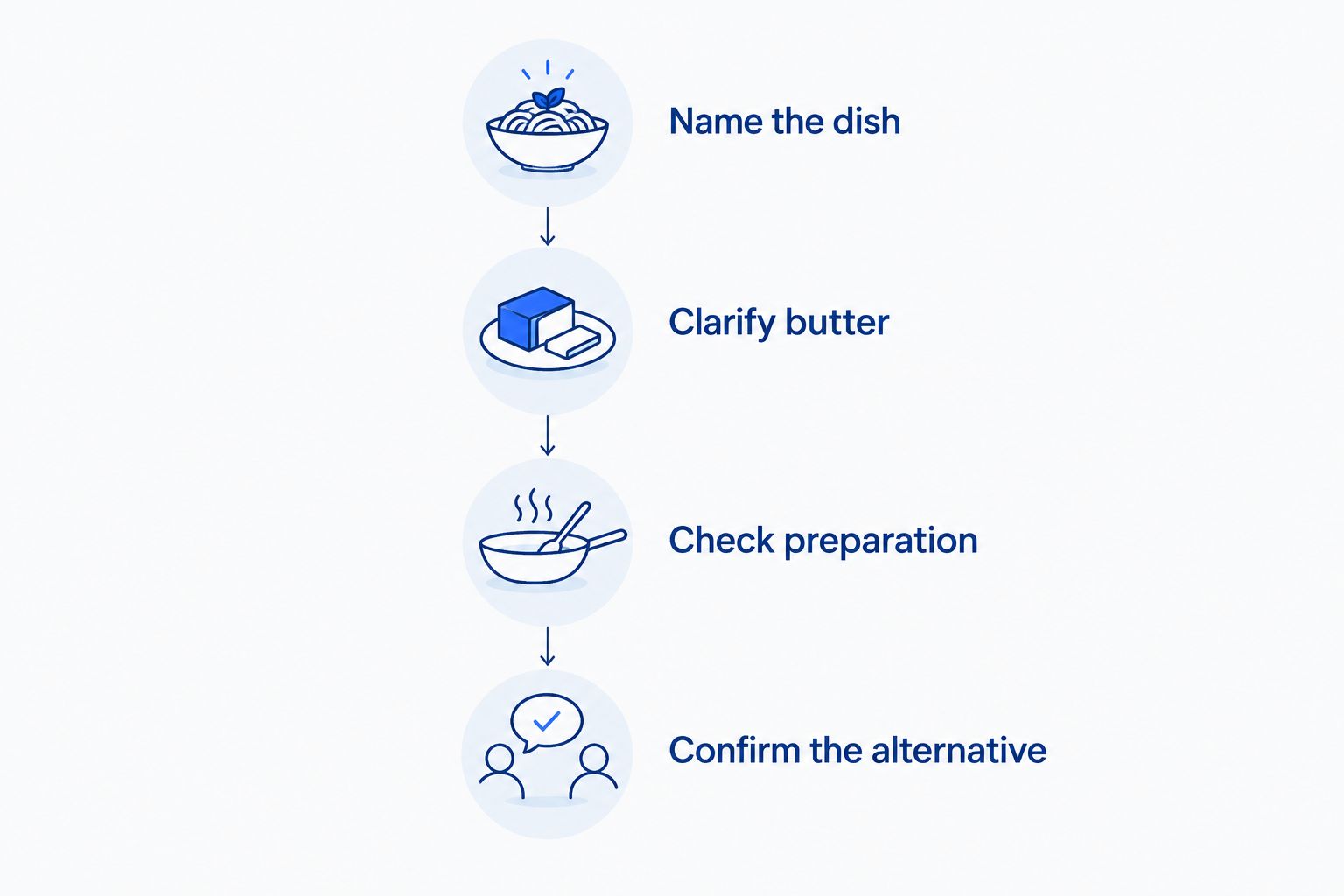
- Name the dish. Ask whether that particular preparation can be made with less added oil. Do not assume an answer about one dish applies to the entire menu.
- Clarify butter. If your goal concerns total cooking fat, ask about butter as well as oil. If the concern is dairy, state that directly.
- Ask what is already prepared. Find out whether the oil is already cooked into the dish or would be added when your portion is made.
- Confirm the alternative. If the recipe cannot change, ask which other preparation better matches your request. Make the decision before placing the order.
A useful request is: Please use less added oil if this dish can be adjusted, and let me know if the oil is already part of the prepared recipe. This wording gives the kitchen permission to explain a limit instead of promising an impossible change.
For a personal preference, keep the request short. For a medical restriction, explain the restriction first and ask whether staff can provide the information you need; an informal less-oil request does not establish a measured fat content.
Less added oil: ask what happens during cooking
Best for: diners who prefer a less oily preparation without requiring an oil-free meal. This request targets oil the cook would otherwise add to your individual portion.
Its advantage is clarity: you are asking for a specific adjustment rather than a vaguely lighter dish. Its limitation is equally important: it does not remove fat already present in cooked ingredients, a seasoning mixture, or a prepared sauce.
Ask whether the dish is cooked individually or served from a prepared batch. If it comes from a batch, the practical answer might be another dish rather than a modified portion.
Do not treat a lack of visible oil as proof of low fat. Fat can be mixed throughout a sauce without forming an obvious layer on top.
No finishing fat: separate the topping from the recipe
Best for: diners who want to avoid an additional oil or butter finish. Ask whether anything is added after cooking and whether that addition can be omitted.
The benefit is that the request concerns a distinct step. The drawback is that skipping a finish does not change everything that happened earlier in the kitchen.
This distinction matters when a dish looks glossy. Appearance alone cannot tell you whether the fat came from the cooking process, the ingredients, or a final addition.
Do not ask staff to drain a finished dish as a substitute for checking the recipe. Removing liquid from the surface does not establish how much fat remains in the portion.
A different preparation: choose an explainable alternative
Best for: diners whose original choice cannot be adjusted. Ask staff to identify another preparation and explain how its cooking method differs.
The advantage is that you can choose something compatible with the kitchen's actual process. The limitation is that a different name, vegetable ingredient, or mild seasoning does not establish lower oil content.
Vegetable and lentil dishes can contain oil, while some meat preparations contain butter. Treat the main ingredient as the beginning of your questions, not the answer to them.
For Ethiopian dining in 2026, a specific explanation is more useful than a broad label such as light, healthy, or traditional. Ask what goes into the preparation you will actually receive.
Why the ability to reduce oil varies
The deciding factor is the recipe and preparation stage, not whether Ethiopian cuisine permits a request. These details explain why a kitchen can adjust one dish but not another:
- Preparation timing. Oil already incorporated into a cooked batch cannot be excluded from an individual serving.
- Cooking method. A separately cooked portion offers different adjustment points from a long-simmered stew.
- Type of fat. Asking about oil alone does not establish whether a recipe includes butter, including Ethiopian spiced clarified butter known as niter kibbeh.
- Seasoning base. Fat can be part of the cooked onion-and-spice mixture rather than a separate topping.
- Serving format. A shared platter places several preparations together, so a request must identify which components it covers.
None of these factors establishes the fat content of a restaurant's dish. They explain which questions produce a useful answer.
Does less oil mean less spicy Ethiopian food?
Less oil does not mean less spice. Chili heat and cooking fat are separate parts of a recipe, so ask for both changes if both matter to you.
A mild dish can still contain oil or butter. A spicy dish is not automatically higher in fat simply because it contains chili seasoning.
For your 2026 order, state each preference independently: less added oil, plus your preferred level of heat. Staff can then explain whether either request changes the available preparation.
Can you request less oil on a shared Ethiopian platter?
You can ask, but the request must identify the components and the diners it concerns. A shared platter can contain several preparations with different recipes, so a single less-oil instruction leaves room for confusion.
Before ordering, agree whether everyone wants the same adjustment. If one person needs different handling, ask whether separate serving is possible rather than assuming the entire platter can be changed.
Separate serving can make the request easier to communicate, but it does not establish allergen safety or measured nutrition. Those needs require their own discussion.
Is less oil enough for a medical diet or dairy allergy?
No: less oil is a preference, not a medical or allergy specification. If you need to avoid dairy, ask about butter and other dairy ingredients; reducing oil does not address them.
If your clinician has prescribed a fat limit, follow that guidance rather than translating it into a restaurant preference. A kitchen's agreement to use less oil does not establish the grams of fat in your meal.
For allergies, also discuss preparation and cross-contact. Do not treat an ingredient substitution or an omitted finish as confirmation that the meal meets your allergy needs.
What should you confirm before ordering at Tsehaydc?
Tsehaydc is best suited to diners seeking traditional Ethiopian restaurant dining in Adams Morgan. That location and cuisine are the reason to consider it, not evidence of a particular dietary modification policy.
Before ordering, identify your dish and ask whether its preparation allows less added oil. If the answer is no, ask about another preparation rather than requesting that staff remove fat already cooked into the food.
The useful outcome is a clear answer about the meal you are choosing. Do not assume a special recipe, oil-free preparation, nutrition calculation, or allergy accommodation without direct confirmation.
FAQ
Can you request less oil in Ethiopian food when dining out?
Yes, you can request less oil in Ethiopian food, but the kitchen must confirm whether your chosen dish can be adjusted. Ask before ordering and distinguish less added oil from an oil-free preparation.
What should I say when I want less oil?
Ask whether the specific dish can be prepared with less added oil and whether it already contains butter or oil. Request another preparation if the original recipe cannot be changed.
Can a restaurant remove oil from an Ethiopian stew?
Oil already mixed into a cooked stew cannot simply be removed from your individual portion. Ask whether another preparation better matches your preference.
Are vegan Ethiopian dishes always low in oil?
No, vegan describes the exclusion of animal-derived ingredients, not a low oil content. Ask about the cooking method and added oil separately.
Does ordering mild Ethiopian food reduce the oil?
No, mild seasoning does not establish lower oil content. Ask about chili heat and cooking fat as separate preferences.
Does less oil also mean no Ethiopian butter?
No, a request for less oil does not clearly communicate a request to omit butter. Ask about both, and explicitly identify a dairy allergy when that is the concern.
Can I request no oil at all?
You can ask for no oil, but the kitchen must confirm whether any suitable preparation meets that requirement. Less added oil is not the same as no oil.
Can a less-oil request guarantee a medically low-fat meal?
No, a less-oil request does not establish the meal’s measured fat content. Follow your clinician’s guidance and confirm whether the restaurant can provide the information your restriction requires.
One last thing
Ask what can change, not just whether the kitchen can use less oil. A general yes leaves an important question unanswered: does it refer to a finishing addition, your individual portion, or the whole recipe?
For your next Ethiopian meal in 2026, finish the conversation by confirming the actual adjustment. If the kitchen cannot change the dish, choosing something else is clearer than expecting a finished stew to become a different recipe.
Related guides
- Can you order non-spicy Ethiopian dishes?
- Can vegans eat at Ethiopian restaurants?
- Is shiro vegan?
- Is Ethiopian food meant to be eaten communally?