
For wheelchair-accessible restaurants in Adams Morgan in 2026, choose a venue that confirms access to the entrance, dining table, and restroom—not just the front door. Tsehay Restaurant & Bar serves traditional Ethiopian cuisine in Adams Morgan; confirm the full access route before planning your visit.
- Compare wheelchair accessible restaurants Adams Morgan by entrance, table access, restroom layout, and arrival route.
- Tsehay Restaurant & Bar serves Ethiopian cuisine in Adams Morgan; confirm accessibility details before choosing it.
- A step-free entrance alone does not establish access to dining tables or restrooms.
- Choose the restaurant that confirms your specific requirements, not the one with the broadest accessibility claim.
Why this matters
The best restaurant for a wheelchair user is the one whose confirmed layout supports the entire visit. An entrance that works for you is only the beginning. You also need to reach your table, position your chair comfortably, and use any facilities you require.
Accessibility is not interchangeable between diners. A manual wheelchair, a power wheelchair, and a mobility scooter have different space and turning requirements. Your preferences about assistance, transfers, and restroom use also belong in the decision.
For a 2026 dinner plan, ask about the actual route you will use. A precise answer about a doorway or table is more useful than a general assurance that everyone is welcome.
What makes the best wheelchair-accessible restaurant?
Use these criteria before comparing cuisine or atmosphere:
- Entrance access: A step-free approach, usable doorway, and clear explanation of any ramp or lift.
- Dining access: A continuous route to the seating area without steps or furniture blocking your path.
- Table fit: Space for your chair, knees, footrests, and companions at the intended table.
- Restroom access: A reachable restroom with the doorway, interior layout, and transfer space you require.
- Arrival route: A workable connection from your drop-off point, parking location, or transit stop to the entrance.
- Specific confirmation: Staff can describe the layout and confirm the arrangement for your visit.
Treat these as separate checks. A strong answer on one does not substitute for an answer on another.
Access options at a glance
These ranked profiles describe restaurant layouts to ask about, not accessibility certifications for individual Adams Morgan businesses. Use them to compare answers from restaurants on your shortlist.
| Rank and access profile | Best for | Standout feature | Key limitation |
|---|---|---|---|
| 1. Step-free, single-level dining | Diners seeking a route without ramps or lifts | Entrance, table, and restroom connected on one level | Doorways, thresholds, and table clearance still need checking |
| 2. Ramp-served dining | Diners comfortable using a confirmed ramp route | A ramp provides an alternative to entrance steps | Slope, landing space, and deployment affect usability |
| 3. Lift-served dining | Diners considering a restaurant with level changes | A lift connects otherwise separated areas | Operation, platform fit, and staff procedures need confirmation |
Prefer the simplest confirmed route that meets your needs. These profiles rank the complexity of the access route, not the food, service, or quality of any restaurant.
1. Step-free, single-level dining: best for a simpler route
A step-free restaurant route connects the outside approach, dining area, and required facilities without stairs. When those areas share one level, you do not have to incorporate a ramp or lift into the visit.
That does not settle every access question. A raised threshold, narrow doorway, tightly arranged tables, or unsuitable restroom still matters.
Step-free dining pros:
- Avoids stairs along the confirmed route.
- Removes the need to use a lift between dining and restroom areas.
- Lets you ask about one continuous route through the restaurant.
Step-free dining cons:
- Level floors do not establish sufficient doorway clearance.
- A reachable table does not establish usable knee space.
- Restroom access requires a separate check.
Best for: Diners who want to avoid ramps, lifts, and changes of level.
Ask whether the route stays step-free from the exterior entrance to the actual table and restroom. Include the entrance threshold in the question; a description of the dining room alone leaves that detail unresolved.
Verdict: Hold the booking until the restaurant confirms the complete route and table fit. Once those details match your requirements, this is the first access profile to prioritize.
2. Ramp-served dining: best for a confirmed alternative to steps
A ramp can provide access where an entrance has a change in level. Its usefulness depends on the approach, slope, clear width, landings, and connection to the doorway.
Distinguish a permanently installed ramp from a portable ramp that staff must position. Neither description alone tells you whether the route works for your chair or your preferred level of independence.
Ramp-served dining pros:
- Provides an alternative to using entrance stairs.
- Gives you a specific route to assess before arrival.
- Can connect directly to a dining level without a lift.
Ramp-served dining cons:
- Ramp geometry and doorway positioning affect usability.
- A portable ramp introduces a setup step.
- Reaching the entrance does not confirm access inside.
Best for: Diners who are comfortable with a ramp after checking its configuration.
Ask where the ramp starts, whether it is permanently in place, and how the door opens at the top. If you need independent entry, say so explicitly. Do not treat being carried or lifting an occupied wheelchair as a substitute for the access route you requested.
Verdict: Hold until the ramp arrangement and the route beyond it are confirmed. Choose this profile only when the details meet your needs.
3. Lift-served dining: best for confirmed access between levels
A lift can connect an entrance, dining room, or restroom on different levels. For your visit, the relevant questions are whether the lift serves every required area and whether your mobility device fits.
Ask about operation as well as location. A lift that requires a key or staff assistance adds a procedure you need to understand before arriving.
Lift-served dining pros:
- Provides an alternative to stairs between served levels.
- Gives you a defined way to reach separated restaurant areas.
- Lets you assess platform fit before committing to a visit.
Lift-served dining cons:
- Access depends on the equipment being operational.
- Platform dimensions and entry orientation affect fit.
- Staff-controlled operation adds a coordination requirement.
Best for: Diners comfortable using a lift with confirmed dimensions and procedures.
For a 2026 visit, confirm operation close to the date rather than relying solely on an older description. Ask whether the same lift route is usable when you leave and when you need the restroom.
Verdict: Hold until operation, device fit, and access to all required levels are confirmed. A lift is a useful access route when its actual arrangement works for you.
Considering Ethiopian dining at Tsehay Restaurant & Bar
Tsehay Restaurant & Bar is a choice for diners seeking traditional Ethiopian cuisine in Adams Morgan. Choose it on that basis after establishing that the physical access arrangement meets your needs.
Start with the wheelchair accessibility guide, then ask about the entrance, seating area, and restroom for your intended visit. A restaurant-specific discussion is more relevant than a general neighborhood label, but your chair and access preferences still determine the questions.
Cuisine-and-location advantages:
- Traditional Ethiopian cuisine is the restaurant's stated focus.
- The restaurant is located in Adams Morgan, Washington DC.
- Its stated services include restaurant dining and a bar.
Access considerations:
- Cuisine and location do not establish physical accessibility.
- Restaurant seating and bar seating require separate checks if you intend to use both.
- Group size and chair positioning belong in the table discussion.
Best for: Diners seeking Ethiopian restaurant dining in Adams Morgan who have confirmed their access requirements.
Verdict: Hold the dining plan until the entrance, table, and required facilities are confirmed. Decide on access first, then build the meal around your preferences.
Check the whole route before you book
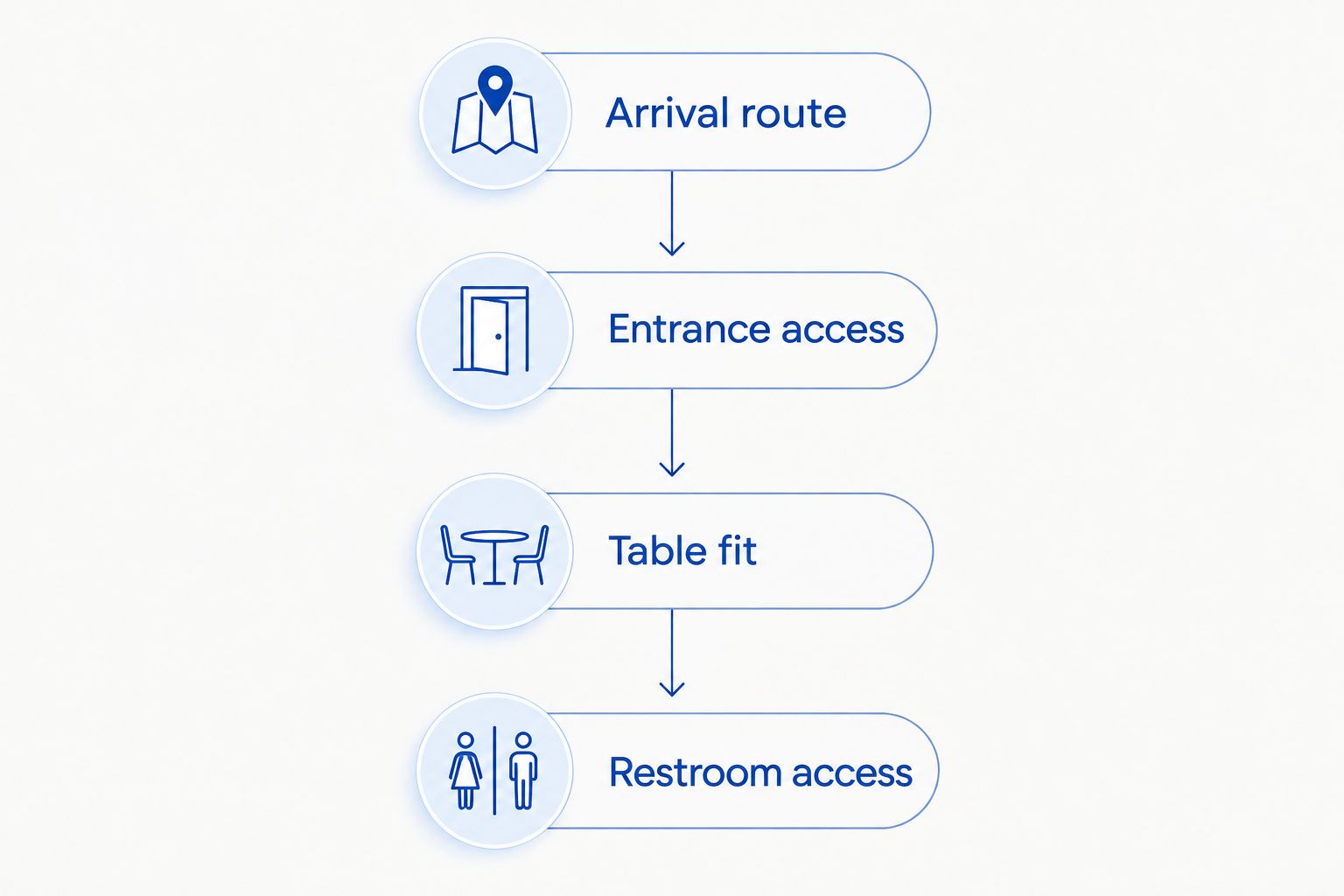
Break the visit into separate parts. This keeps a conversation with restaurant staff focused and prevents an answer about the entrance from standing in for an answer about everything else.
Arrival route
Identify where you expect to arrive: a vehicle drop-off, a parking location, or a transit stop. Then check the route from that point to the entrance, including crossings, curb transitions, and any change in level.
Ask which entrance staff recommend for wheelchair access. If it is different from the main entrance, request clear directions and confirmation that you can use it during your visit.
Entrance access
Ask whether there are steps, raised thresholds, or doors that require assistance. If a ramp or lift is involved, request a description of its location and operation.
An entrance photograph helps you understand the arrangement, but it does not establish dimensions. Ask for measurements when clearance is the deciding factor.
Table fit
Tell staff that you intend to remain in your wheelchair if that is your preference. Ask for a table rather than assuming that a booth, fixed bench, or high counter will work.
Check the approach to the table as well as the space beneath it. Your companions should be able to sit with you without placing your chair in a circulation route.
Restroom access
Ask whether the restroom is on the dining level and reachable without steps. Then ask about the doorway, internal turning space, grab bars, and transfer arrangement that you need.
A restroom described as accessible is not a substitute for those details. Specify your requirements rather than asking staff to make that judgment for you.
Dimensions that make the questions more useful
The U.S. Access Board's ADA Standards provide useful dimensional reference points for a 2026 access conversation. These are design benchmarks, not proof that a particular restaurant complies or that its layout suits your mobility device.
- Doorway clear width: The standards generally require a minimum clear opening of 32 inches, measured with the door open to the specified position. Ask about clear opening width, not the nominal door size.
- Accessible route width: The standards generally specify 36 inches of clear width, subject to stated exceptions. Ask about the narrowest point on the route to your table.
- Accessible dining surface height: The specified range is 28–34 inches above the floor. Height alone does not establish knee clearance or usable approach space.
Compare actual measurements with your chair and positioning needs. For turning space, door maneuvering, ramps, and restroom transfers, the arrangement matters as much as an isolated measurement.
Do not use these figures as a do-it-yourself compliance verdict. They make your questions more precise; they do not replace the full standards or an assessment of the building.
How the access profiles are ranked
The order prioritizes a confirmed continuous route with fewer access mechanisms: single-level step-free dining first, ramp-served dining next, and lift-served dining third.
That order is a starting point, not a universal preference. A well-suited lift route is a better choice for you than a step-free restaurant with an unsuitable restroom or table.
The deciding criteria remain entrance access, dining access, table fit, restroom access, arrival route, and specific confirmation. Food preferences come after those requirements are satisfied.
Which restaurant should you choose?
Choose the restaurant that gives specific answers matching your requirements. If two restaurants offer food you want, prioritize the one with a confirmed complete route over one offering only a general accessibility assurance.
For Ethiopian dining, consider Tsehay Restaurant & Bar after confirming those details. For any Adams Morgan restaurant, record the agreed entrance and seating arrangement so you can refer to them when you arrive.
Before finalizing your 2026 plan:
- State your mobility device and whether you will remain in it.
- Confirm the entrance and any ramp or lift procedure.
- Confirm the table arrangement and required restroom access.
- Agree on what to do if the arrangement changes.
FAQ
What’s the best wheelchair-accessible restaurant in Adams Morgan?
The best choice is a restaurant that confirms a usable entrance, dining table, and any restroom facilities you require. Compare the complete route rather than choosing from an accessibility label alone.
Is Tsehay Restaurant & Bar wheelchair accessible?
Confirm the entrance, table access, and restroom arrangement directly before planning a wheelchair-accessible visit to Tsehay Restaurant & Bar. Ask about the specific route and your mobility device rather than relying on its cuisine or location.
Does a step-free entrance mean the entire restaurant is accessible?
No, a step-free entrance does not establish access to tables or restrooms. Check the route inside, table clearance, and any changes of level separately.
What should I ask before booking a table with a wheelchair?
Ask about the entrance route, doorway clearance, table arrangement, and restroom layout. State whether you will remain in your wheelchair and whether you require independent entry.
Is a ramp better than a lift for restaurant access?
The better option is the one whose confirmed arrangement meets your requirements. Ramp geometry, lift dimensions, and operating procedures all affect the decision.
Can an accessible dining table be a booth or high counter?
Do not assume a booth or high counter will accommodate your wheelchair. Request a table with a suitable approach and clearance if you intend to remain in your chair.
How should I check restaurant accessibility for a group dinner?
Confirm the table layout for the whole group, including your wheelchair position and a clear route to the restroom. Tell staff the group size and ask that companions can sit with you without blocking circulation.
One last thing
Ask staff to describe the narrowest point, not just the easiest part of the route. A welcoming entrance does not answer whether you can get past a table, turn into a restroom, or position your chair comfortably.
For your 2026 dinner, make the access arrangement part of the plan—not a problem to solve after arrival.
Related guides
- Parking near Tsehay Restaurant & Bar
- Distance from the nearest Metro station
- Planning dining for a large group