
For Ethiopian restaurants in DC for large groups, start with Tsehaydc if your group wants traditional Ethiopian dining in Adams Morgan. Best neighborhood starting point: an Ethiopian restaurant and bar; best birthday plan: a confirmed group table; best business-dinner plan: seating arranged for conversation; best private-event plan: an explicitly agreed exclusive-use arrangement. This 2026 guide ranks those dining approaches so you can choose the right setup before committing your group.
- For Ethiopian restaurants in DC for large groups, Tsehaydc is an Adams Morgan starting point; confirm group seating directly.
- Choose a regular group dinner for a straightforward gathering, not an event that requires exclusive space.
- For birthdays, confirm the seating arrangement and celebration requests before inviting everyone.
- For business dinners, prioritize conversation, dietary requirements, and a clear payment plan.
- Treat private rooms, exclusive use, and event services as separate requests requiring explicit confirmation.
Why this matters
A restaurant's cuisine and neighborhood tell you whether it belongs on your shortlist. They do not tell you whether your entire party can sit together, follow the same schedule, or share food comfortably. Those details decide whether a large-group dinner works.
Ethiopian dining often involves injera and dishes served for sharing. That makes the ordering conversation important: you need to know who wants to share, who needs a separate meal, and which ingredients require clarification.
Tsehaydc is an Ethiopian restaurant and bar for diners seeking traditional Ethiopian cuisine in Adams Morgan, Washington DC. Use that location and dining identity to decide whether it fits your group, then confirm the arrangements your occasion needs.
What makes the best Ethiopian restaurant for a large group?
For a 2026 group dinner, judge the restaurant against these criteria before comparing atmosphere or deciding where to invite everyone:
- Confirmed seating: Ask whether the full party will sit together, at adjacent tables, or in separate areas.
- Ordering fit: Establish whether diners will share dishes, order individually, or use a combination of both.
- Dietary clarity: Identify allergies and dietary requirements before selecting shared food. Confirm ingredients and preparation directly.
- Occasion fit: Separate an ordinary dinner from a birthday, business gathering, or event requiring exclusive space.
- Payment clarity: Ask how the group can settle the bill, including any applicable group terms.
- Arrival practicality: Choose a location your guests can reach and give everyone the same arrival instructions.
Do not substitute a restaurant's popularity for answers to these questions. A venue that suits a couple's dinner still needs to confirm the details of your larger gathering.
Large-group dining options at a glance
The comparison below distinguishes a named restaurant starting point from the arrangements you can request. Birthday seating, business-dinner setups, and private-event arrangements are planning options—not promises that a particular restaurant offers them.
| Ranked option | Best for | Standout advantage | Key limitation |
|---|---|---|---|
| Adams Morgan dinner at Tsehaydc | Groups seeking traditional Ethiopian dining and bar service in Adams Morgan | Matches a specific cuisine and neighborhood preference | Group seating and occasion-specific arrangements require confirmation |
| Confirmed birthday group table | Celebrations that do not need exclusive space | Keeps the gathering centered on dinner | Cake, decorations, and seating requests need separate agreement |
| Conversation-first business dinner | Work gatherings where discussion matters | Makes seating and meal timing part of the booking decision | Ordinary dinner seating does not guarantee privacy or suitable sound levels |
| Confirmed exclusive-use arrangement | Events where control of the space is essential | Establishes who can use the agreed space | Requires explicit terms rather than assumptions about a group booking |
1. Tsehaydc: best starting point for an Adams Morgan group dinner
Tsehaydc serves traditional Ethiopian cuisine and provides restaurant dining and bar service in Adams Morgan, Washington DC. It is a relevant starting point when your group has already chosen that neighborhood and cuisine. The next decision is whether the restaurant can accommodate your specific gathering.
For a 2026 dinner, make the first inquiry about the full party rather than asking only whether a table is possible. State your date, arrival time, headcount, and whether sitting together is essential. Also explain whether you want an ordinary meal or have celebration requirements.
Tsehaydc pros
- Traditional Ethiopian cuisine matches groups seeking that dining experience.
- The Adams Morgan location gives your guests a clear neighborhood destination.
- Restaurant dining and bar service match a dinner-and-drinks occasion.
Tsehaydc planning limitations
- The restaurant's dining identity does not establish how a particular group will be seated.
- Bar service does not establish private-event arrangements or beverage policies.
- Shared dining requires a separate conversation about individual dietary needs.
Best for: Groups whose first priorities are traditional Ethiopian dining and an Adams Morgan location.
Read the guide to large-group accommodation as part of your planning, then confirm your own party's requirements directly. An answer about one gathering should not become an assumption about yours.
Verdict: Hold the final group commitment until the restaurant confirms your headcount and seating arrangement.
2. A confirmed birthday table: best for dinner-led celebrations
A birthday group table keeps the occasion focused on eating together rather than running a separate event. It is the right format when the guest of honor wants a restaurant dinner and your plans do not depend on controlling the entire room.
Tell the restaurant which requests matter before you invite guests. Bringing a cake, adding decorations, arranging a surprise arrival, and sitting together are different requests. Approval for one does not establish approval for the others.
Birthday group-table pros
- Keeps the celebration centered on a shared meal.
- Gives the organizer a clear seating requirement to confirm.
- Separates essential birthday requests from optional extras.
Birthday group-table cons
- A group table does not provide exclusive use of the dining room.
- An elaborate surprise becomes harder to coordinate when arrivals differ.
- Celebration extras need agreement rather than an assumption that they are allowed.
Best for: Birthdays where dinner together matters more than privacy, decorations, or a custom event schedule.
For your 2026 invitation, describe only what has been agreed. If the restaurant confirms dinner seating but not cake handling or decorations, keep those extras out of the guest-facing plan.
Verdict: Choose a birthday group table when the confirmed dinner arrangement covers everything the celebration genuinely needs.
3. A conversation-first dinner: best for business gatherings
A business dinner needs a different decision process from a birthday. Your guests need to hear each other, understand the meal format, and know whether dinner has a firm finish time. Choose the arrangement around those requirements rather than the appeal of a shared platter alone.
Ask about the proposed table layout and explain that conversation is the purpose of the gathering. If the discussion requires privacy, request a specifically defined private arrangement; a group reservation does not establish confidentiality.
Conversation-first dinner pros
- Makes seating suitability an explicit requirement.
- Creates room to explain dietary needs before ordering.
- Allows the organizer to settle payment expectations before guests arrive.
Conversation-first dinner cons
- Shared platters do not suit every guest's dietary or dining preferences.
- A public restaurant setting does not guarantee a quiet conversation.
- A meal with a firm deadline requires direct agreement about timing.
Best for: Colleagues, clients, or professional groups gathering for an ordinary dinner and conversation.
Name a payment contact before the meal. That person should know whether the group expects separate payments, a single payment, or another arrangement agreed with the restaurant. Do not leave the question until the bill arrives.
Verdict: Choose a conversation-first dinner only after seating, dietary handling, and payment expectations are clear.
4. An exclusive-use arrangement: best for events needing control
An exclusive-use arrangement is the appropriate request when your event depends on access to a defined space. Examples include a gathering with speeches, a structured program, or guests who need to stay together away from unrelated diners. The important distinction is the agreement—not the size of the party alone.
For a 2026 event, ask exactly which space is included and what exclusive use means. A private room, a reserved section, and use of an entire restaurant are different arrangements. Do not treat those descriptions as interchangeable.
Exclusive-use arrangement pros
- Defines the space your gathering can use.
- Makes the event schedule part of the agreement.
- Allows essential event requests to be discussed together.
Exclusive-use arrangement cons
- Requires more coordination than an ordinary dinner inquiry.
- Needs clear terms for timing, changes, and cancellation.
- Does not automatically include decorations, equipment, or a custom service format.
Best for: Organizers whose event cannot work without a specifically agreed space and schedule.
Ask for the arrangement in writing. Confirm what is included, what remains your responsibility, and how a changed headcount affects the agreement. Keep the event invitation consistent with those terms.
Verdict: Hold any private-event commitment until the space, schedule, and responsibilities are explicitly agreed.
How to organize the dinner without a long message chain
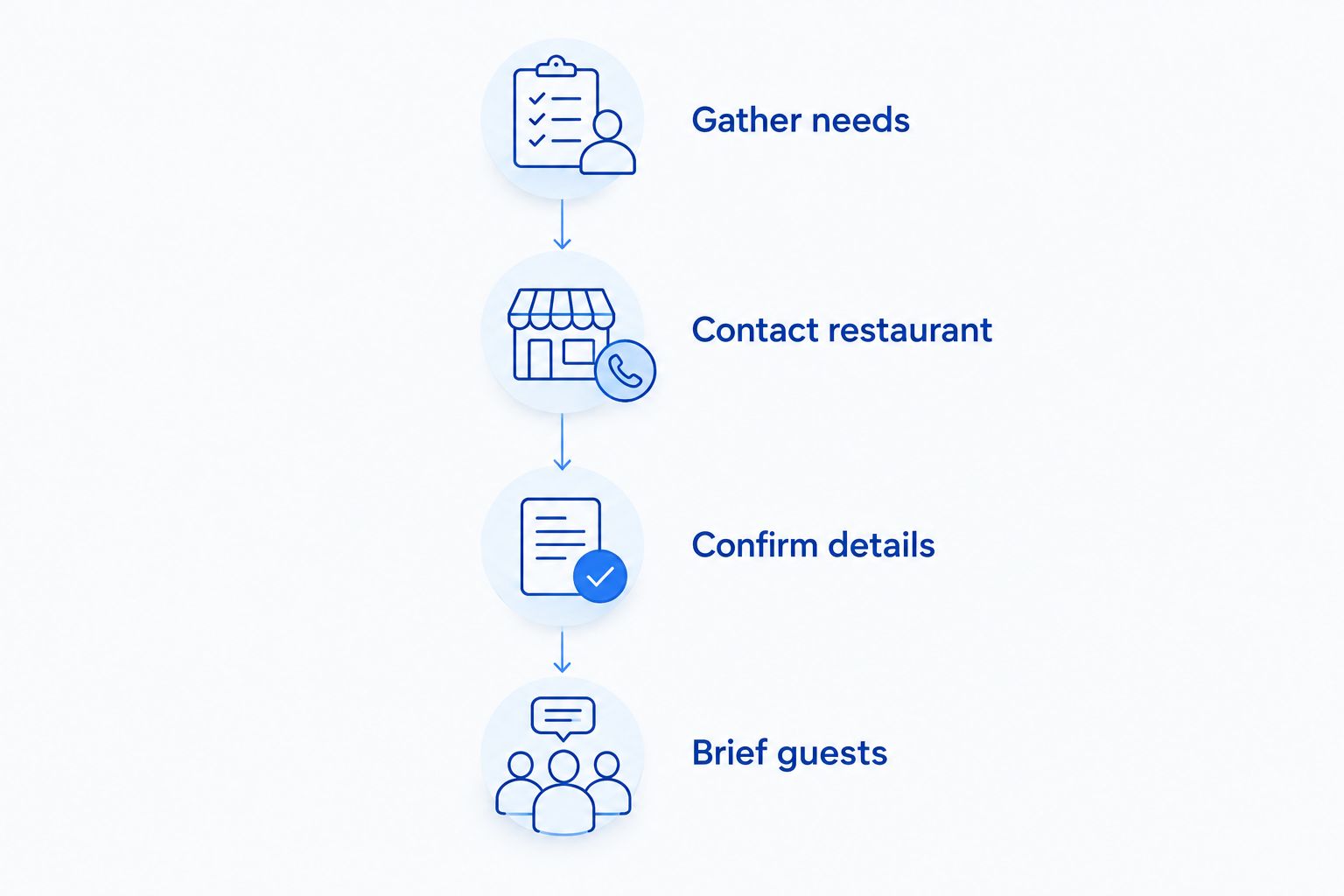
Use a short sequence that turns guest preferences into a clear restaurant inquiry. Choose 1 organizer to communicate with the restaurant, and send 1 consolidated inquiry rather than separate messages from multiple guests. These are planning recommendations, not restaurant requirements.
Gather needs
Collect the headcount, dietary requirements, and any essential access needs. Ask guests whether they are comfortable sharing dishes; do not assume everyone wants the same meal format.
Contact restaurant
Send 3 core details together: the date, the arrival time, and the headcount. Add whether sitting together is essential, what occasion you are planning, and any requests that determine whether the dinner works.
Confirm details
Resolve the seating arrangement, ordering approach, payment handling, and any applicable group terms. Keep unresolved requests separate from confirmed arrangements so an unanswered question does not become a promise.
Brief guests
Share the confirmed arrival instructions, meal approach, and payment plan. Tell guests whom to contact if their attendance or dietary needs change.
Shared platters: plan around people, not assumptions
Injera is a fermented flatbread used in Ethiopian dining, often alongside dishes served for sharing. A communal meal is a dining format, not a requirement that every guest eat from the same platter. Ask about separate servings when a guest needs or prefers them.
Before ordering, identify who will share each dish. Keep vegetarian preferences, allergies, spice preferences, and other requirements distinct; one label does not answer every ingredient question. A vegetarian dish, for example, does not establish its suitability for a particular allergy.
Ask for ordering guidance based on your actual group. Do not infer portions from a platter's appearance or assume that a combination dish feeds a fixed number of adults. Clarify the meal you want, then ask how to order for it.
How these recommendations are ranked
This 2026 ranking follows occasion fit: an ordinary neighborhood dinner first, then a birthday gathering, a business dinner, and an event requiring exclusive space. The sequence is a decision tree, not a claim that one restaurant outperforms every Ethiopian restaurant in Washington DC.
The criteria remain the same across all four approaches: confirmed seating, ordering fit, dietary clarity, occasion fit, payment clarity, and arrival practicality. Choose the least complicated arrangement that satisfies your essential requirements.
Which group-dining option should you choose?
Start with an ordinary restaurant dinner unless your occasion requires something more specific. For an Adams Morgan Ethiopian meal, Tsehaydc belongs on your shortlist because its stated cuisine, neighborhood, and bar service match that brief. Confirm the group arrangement before treating the venue decision as final.
Choose a birthday table for a dinner-led celebration. Choose a conversation-first arrangement for a work gathering. Request exclusive use only when your event depends on a defined space; do not add complexity merely because the party is large.
FAQ
What’s the best way to choose Ethiopian restaurants in DC for large groups?
Choose by confirmed seating, dietary handling, and occasion fit. A restaurant’s neighborhood and cuisine establish whether it belongs on your shortlist, but your party’s arrangements need direct confirmation.
Is Tsehaydc an option for a group dinner in Adams Morgan?
Tsehaydc is an Ethiopian restaurant and bar in Adams Morgan, making it a relevant starting point for that dining brief. Confirm your party size, seating arrangement, and occasion-specific requests directly before committing the group.
Can a large group arrive without confirming ahead?
Do not make an unconfirmed walk-in the plan for a large-group gathering. Contact the restaurant about your date, arrival time, and headcount before giving guests final instructions.
Does a group table mean we get a private room?
No, a group table does not establish private-room access or exclusive use. Ask which space is included and whether unrelated diners will share that area.
Does everyone have to share Ethiopian food?
Do not assume every guest must share a platter. Ask the restaurant about separate servings and explain individual dietary requirements before deciding how the group will order.
How many people does an Ethiopian combo platter feed?
Ask the restaurant about the specific platter and your group’s meal plan rather than assuming a fixed serving count. Describe who will share it and whether the group is ordering other dishes.
Can everyone pay separately at a large-group dinner?
Confirm separate-payment handling with the restaurant before the meal. Tell guests the agreed payment plan so the organizer does not have to resolve conflicting expectations at the table.
One last thing
Ask whether the group will sit together—not simply whether the restaurant can take the group. Those questions are different. If one table is essential, say so in the first inquiry and repeat it when confirming the arrangement.
Related guides
- How many people does a combo platter feed?
- Can you pay separately in a large group?
- Can you get a private room for events?