
Best overall approach: verify ingredients and kitchen handling before choosing a restaurant. Best for shared meals: request separate plating and utensils. Best for complex allergies: discuss a simplified order with staff before committing. This 2026 guide to allergy-friendly dining in Adams Morgan explains how to assess those options, including traditional Ethiopian dining at Tsehay Restaurant & Bar.
- For allergy friendly restaurants adams morgan searches, choose verified ingredients and preparation practices over cuisine labels.
- Tsehay Restaurant & Bar serves traditional Ethiopian cuisine in Adams Morgan; confirm allergy-specific arrangements directly.
- Separate plating helps control sharing at the table but does not establish safe kitchen preparation.
- Vegan dishes and teff-based injera still require ingredient and cross-contact checks.
Why this matters
The best restaurant for a food allergy is one that can explain your specific meal’s ingredients and preparation. A welcoming answer is not enough. You need an answer about the food you will actually eat.
For 2026 dining decisions, distinguish an ingredient check from a preparation check. A dish without your allergen as an intended ingredient still needs assessment for cross-contact: the unintended transfer of an allergen through equipment, surfaces, hands, or other food.
Tsehay Restaurant & Bar is an Adams Morgan option for diners seeking traditional Ethiopian cuisine. That identity tells you what kind of dining experience to explore, not whether a particular allergy can be accommodated. Choose the restaurant only after staff confirm arrangements that fit your needs.
What makes the best allergy-friendly restaurant?
Use these criteria before comparing restaurants or ordering approaches:
- Ingredient clarity: Staff can check the complete recipe, including bread, sauces, spice mixtures, garnishes, and cooking fats.
- Preparation clarity: Staff can explain relevant shared equipment, work surfaces, utensils, and handling steps.
- Specific communication: The conversation names your allergen rather than relying on broad terms such as healthy or dietary-friendly.
- Service consistency: The allergy information reaches the person preparing the food and the person delivering it.
- An honest limit: Staff tell you when they cannot verify an ingredient or meet the requested preparation conditions.
These criteria apply to every restaurant in Adams Morgan. A cuisine category, vegetarian symbol, or enthusiastic recommendation cannot replace them.
Allergy-friendly dining options at a glance
These are ranked ordering approaches, not claims that a restaurant has passed an allergy assessment. Use ingredient verification as the default, then add separate plating or recipe simplification when relevant.
| Rank and option | Best for | Main advantage | Key limitation |
|---|---|---|---|
| 1. Ingredient-verified ordering | Choosing a restaurant and dish | Establishes what goes into the complete meal | Ingredient checks alone do not address cross-contact |
| 2. Separate-plate ordering | Dining with companions who order different foods | Keeps serving and eating arrangements distinct | Separate plates do not establish separate kitchen preparation |
| 3. Simplified ordering | Managing several ingredient exclusions | Reduces the components that need checking | Changes depend on the recipe and kitchen’s ability to accommodate them |
For 2026, start with ingredient-verified ordering regardless of which restaurant you choose. The other approaches supplement that check; neither replaces it.
1. Ingredient-verified ordering: best for choosing your meal
Ingredient-verified ordering means asking staff to check the actual recipe rather than judging a dish by its name. The discussion includes accompaniments and preparation, not just the main ingredient. Use this approach before deciding that a restaurant suits your allergy.
For Ethiopian dining, ask about injera, stews, spice mixtures, and cooking fats. Teff is naturally gluten-free, but the grain’s properties do not establish the ingredients or handling of a restaurant’s injera. Confirm the flour mixture and preparation separately.
Ingredient-verified ordering pros:
- Gives you information about the complete meal.
- Identifies components that a short menu description leaves out.
- Supports a clear discussion about a specific allergen.
- Creates a basis for checking preparation practices.
Ingredient-verified ordering cons:
- Staff need access to reliable recipe and ingredient information.
- Purchased components still need their own checks.
- A verified ingredient list does not eliminate cross-contact concerns.
Best for: Diners choosing a restaurant or assessing an unfamiliar dish.
Ask 3 questions: What contains my allergen? What preparation equipment is shared? Who will confirm the order before it reaches the table? Treat vague answers as unresolved questions, not permission to proceed.
Verdict: Hold the order until both ingredients and preparation are confirmed.
2. Separate-plate ordering: best for shared meals
Separate-plate ordering keeps your food distinct from dishes that companions share. Ask about individual portions, serving utensils, and how the meal reaches the table. This addresses table-level sharing without assuming anything about kitchen practices.
The guide to whether Ethiopian food is meant to be eaten communally provides context for planning a shared meal. For an allergy-sensitive order, discuss serving arrangements directly rather than assuming that the usual presentation fits your needs.
Separate-plate ordering pros:
- Makes it easier to identify which food belongs to you.
- Reduces reliance on shared serving utensils at the table.
- Gives companions a clear boundary around your meal.
Separate-plate ordering cons:
- A separate plate does not address shared cooking equipment.
- Serving changes require confirmation before ordering.
- Companions still need to avoid moving food or utensils between dishes.
Best for: Diners eating with a group whose orders include different ingredients.
Request 1 separate plate for your meal and dedicated serving utensils if those arrangements fit your needs. Then confirm how the kitchen will prepare it. Plating is the final step, not evidence that every earlier step was suitable.
Verdict: Hold until separate preparation and serving arrangements are explained.
3. Simplified ordering: best for several ingredient exclusions
Simplified ordering means discussing a meal with fewer components to assess. Ask whether sauces, garnishes, or accompaniments can be left off without leaving the allergen elsewhere in the recipe. Do not assume that a finished stew can be changed after cooking.
This approach gives the conversation a narrower focus. It does not make a dish safe automatically, and it does not require the kitchen to offer changes it cannot reliably carry out.
Simplified ordering pros:
- Reduces the number of components requiring ingredient checks.
- Helps staff understand the requested exclusions.
- Makes the final order easier to repeat back accurately.
Simplified ordering cons:
- Some ingredients are incorporated before an order is placed.
- Removing a garnish cannot remove an allergen from the underlying dish.
- Fewer components do not eliminate shared-equipment concerns.
Best for: Diners discussing several exclusions or a complicated meal.
Make 2 separate checks: whether the proposed recipe meets your ingredient needs, and whether the preparation meets your cross-contact needs. Keep both questions explicit even when the order looks simple.
Verdict: Hold until staff verify the simplified recipe and handling process.
Ethiopian food: what to ask about allergens
Traditional Ethiopian cuisine is a starting point for ingredient questions, not an allergy guarantee. At Tsehay Restaurant & Bar, discuss your needs in relation to the meal you intend to order. General knowledge about a dish cannot establish a restaurant’s recipe.
For 2026 readers, the US Food and Drug Administration identifies 9 major food allergens: milk, eggs, fish, crustacean shellfish, tree nuts, peanuts, wheat, soybeans, and sesame. This US labeling framework does not cover every possible food allergy and does not certify restaurant meals.
Injera and wheat
Ask which flours are used in the injera and whether preparation involves contact with wheat-containing foods. Naturally gluten-free teff does not make every injera recipe gluten-free. Wheat allergy and celiac disease also require different conversations about the diner’s needs.
Cooking fats and milk
Ask what fat is used in each dish. Niter kibbeh is a clarified, spiced butter used in Ethiopian cooking; do not treat clarified butter as suitable for a milk allergy. Confirm the actual recipe rather than assuming a vegetable dish excludes dairy.
Spice mixtures and sauces
Ask staff to check mixtures and prepared components. A spice name alone does not establish every ingredient in a particular blend. The same principle applies to dressings, garnishes, and accompaniments.
Nuts and other specific allergens
Name the exact food you need to avoid. The guide to whether Tsehay can accommodate nut allergies is relevant reading, but your order still requires a direct conversation about ingredients and handling. Do not extend an answer about peanuts to tree nuts, or vice versa.
A clear conversation before you order
Use the same sequence at any Adams Morgan restaurant in 2026: Verify ingredients, Check preparation, Confirm service. Keep the discussion specific enough that staff can act on it.
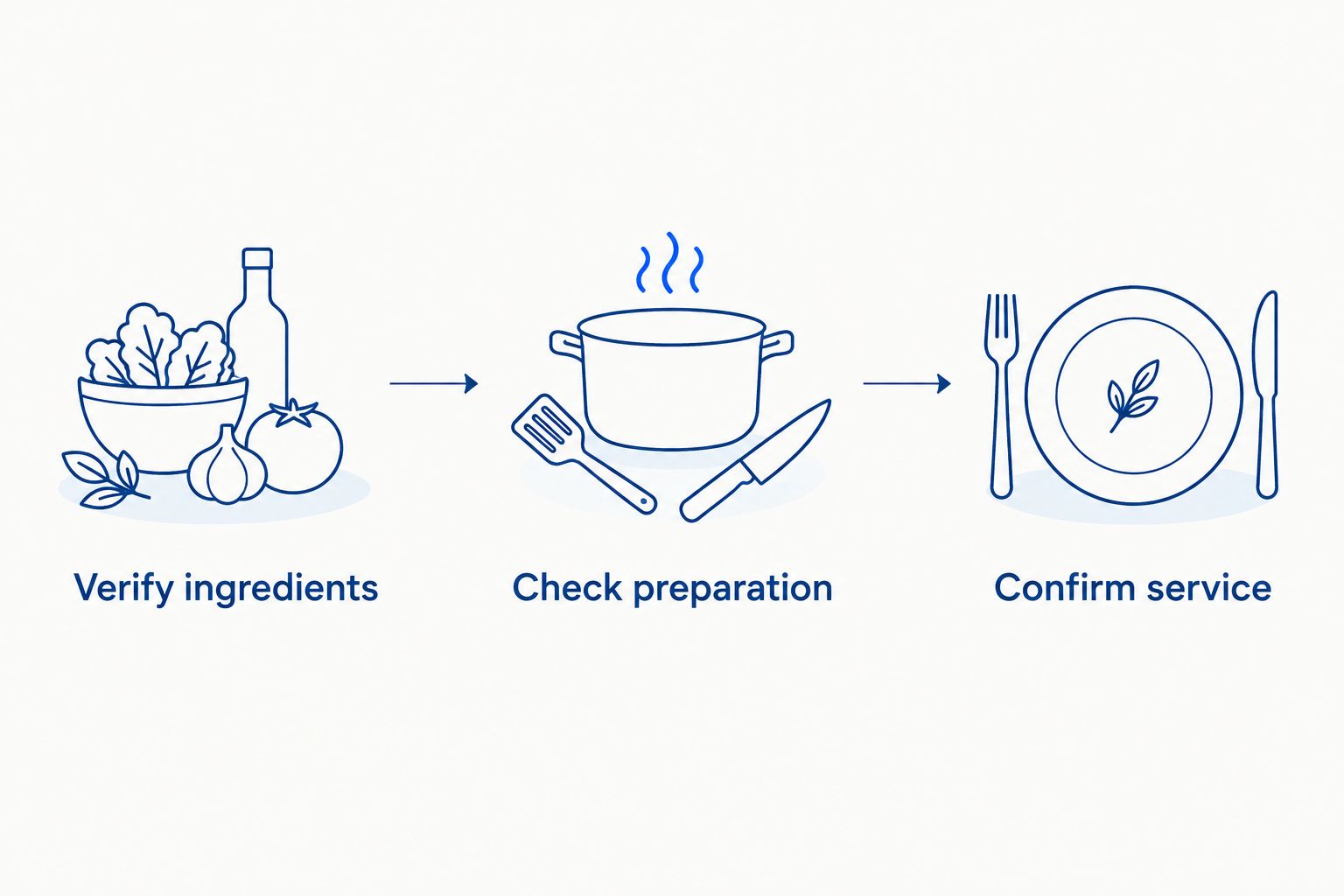
Verify ingredients
Tell staff that you have a food allergy and identify the allergen. Ask them to check the whole meal, including accompaniments. Avoid describing a medical restriction as a preference.
Repeat the proposed order back once the ingredient discussion is complete. If a component changes, check that component rather than relying on the earlier answer.
Check preparation
Ask which relevant utensils, pans, surfaces, or other equipment are shared. Discuss what the kitchen can actually do for your order. A clean-looking dining room tells you nothing about these steps.
Do not negotiate yourself into accepting an answer you cannot assess. If the preparation remains unclear, stop the order and choose another plan.
Confirm service
When the meal arrives, ask whether it is the order prepared with your allergy information. Check that the server can identify it. If there is a mismatch, do not begin eating while the question is being resolved.
Follow your clinician’s allergy management plan, including carrying prescribed emergency medication. Restaurant communication does not replace that plan.
How these options are ranked
Ingredient-verified ordering ranks first because it establishes the information needed to assess the meal. Separate plating ranks next for group dining because it addresses sharing at the table. Simplified ordering serves a different purpose: reducing recipe complexity.
The ranking follows ingredient clarity, preparation clarity, communication, service consistency, and honest limits. None of these approaches establishes that a restaurant is allergen-free.
Which restaurant should you choose?
Choose the restaurant that can answer your ingredient and preparation questions for the meal you want. That is the default recommendation for allergy-friendly dining in Adams Morgan in 2026. Do not substitute popularity or a cuisine label for those answers.
If you want traditional Ethiopian cuisine, consider Tsehay Restaurant & Bar and discuss your specific requirements before ordering. If staff cannot confirm the necessary arrangements, choose a different meal or dining plan rather than treating uncertainty as reassurance.
FAQ
What’s the best way to find allergy-friendly restaurants in Adams Morgan?
Choose a restaurant that can verify your meal’s ingredients and explain relevant preparation practices. Ask about your specific allergen before ordering; a cuisine label or vegetarian symbol is not an allergy assessment.
Is Tsehay Restaurant & Bar suitable for someone with food allergies?
Suitability depends on whether staff can confirm ingredients and preparation arrangements for your specific allergy. Tsehay Restaurant & Bar serves traditional Ethiopian cuisine in Adams Morgan, but that does not establish allergy-specific accommodation.
Is Ethiopian injera always gluten-free?
No, injera should not be assumed to be gluten-free. Teff is naturally gluten-free, but you need to confirm the restaurant’s flour mixture and handling practices.
Are vegan Ethiopian dishes safe for a milk allergy?
A vegan label alone is not enough to assess a restaurant meal for a milk allergy. Confirm the actual ingredients, cooking fats, and relevant cross-contact controls before ordering.
Does a separate plate prevent allergen cross-contact?
A separate plate does not establish protection from cross-contact during preparation. It addresses serving arrangements, while shared equipment and handling need separate checks.
What should I ask about a peanut or tree nut allergy?
Name the specific allergen and ask staff to check every component and relevant preparation step. Peanuts and tree nuts are different allergen categories, so an answer about one does not resolve the other.
What should I do if restaurant staff cannot confirm ingredients?
Do not order a meal whose ingredients or relevant preparation practices remain unresolved. Choose another dining plan and follow your clinician’s allergy management advice.
One last thing
Removing an allergen from a plate is not the same as preparing the meal without it. If an unwanted ingredient arrives on your food, do not accept simply picking it off as the solution. Stop eating and ask staff to explain what happened before deciding your next step.
Related guides